Behaviour analysis starts from an unfashionable truth: there is no universal definition of suspicious. A person standing at a gate for ten minutes is a delivery at noon and an incident at 3 a.m.; a group gathering is a shift change in one zone and a breach in another. Working systems therefore build baselines per route segment and per hour - typical occupancy, typical dwell times, typical movement patterns - learned from the site's own routine rather than shipped as generic rules. Abnormality is then a measured departure from that site's normal, which is the only definition a security team can actually act on.
Normal Is a Local Fact
This is the operating model behind Booster's campus and facility patrol deployments in the industrial inspection and public safety solution: the robot's rounds are scheduled, its viewpoints fixed, and its baseline therefore meaningful - the same route at the same hour produces directly comparable observations night after night.
What the Analysis Actually Detects
In practice, behaviour analysis on patrol covers a practical catalogue: presence in restricted zones, loitering beyond a dwell threshold, movement against the expected flow, objects appearing where none were and remaining static, and occupancy anomalies in areas that should be empty. Each detection is a claim about change, not about intent - the system reports that something is different, attaches the imagery and the map position, and leaves the judgement of meaning to the human on duty. That division of labour is deliberate and it is what keeps the system trustworthy.
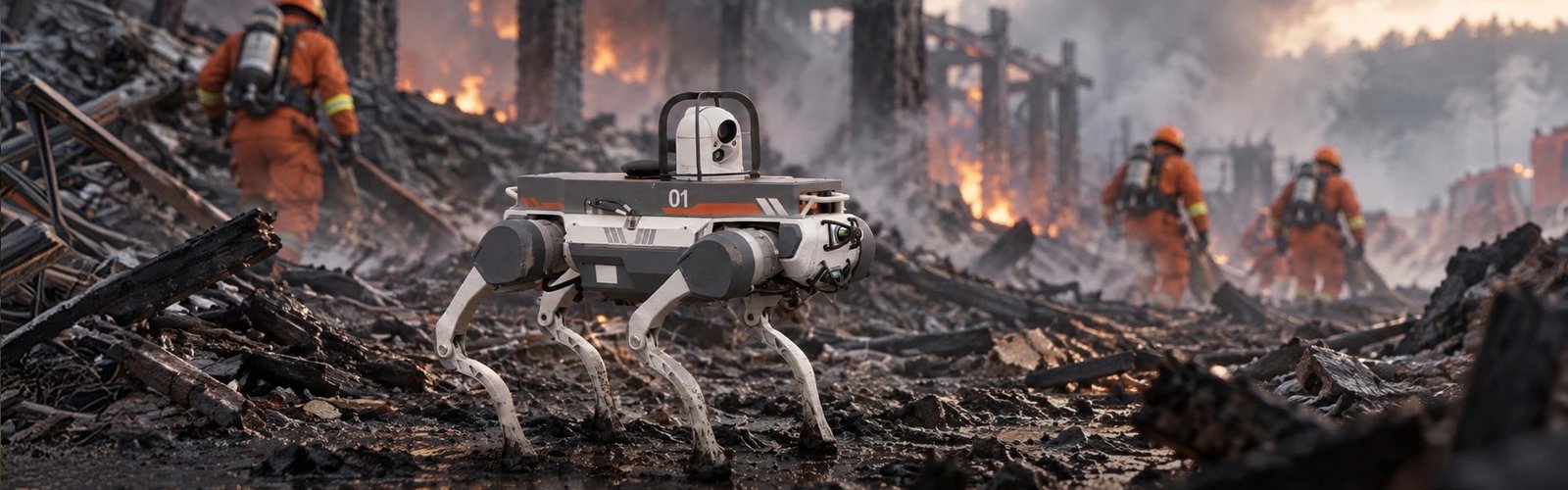
The sensing behind it is the patrol robot's standard fit - visual cameras for classification, thermal channels for presence in darkness, and the navigation stack's position fix so every event is located, not just seen. A security patrol robot dog adds one more advantage: it can move toward an event for a closer look, repositioning its sensors in a way no fixed camera can, under operator direction.
Alerts Are a Workflow, Not a Noise Source
The fastest way to kill a patrol programme is alert fatigue: a system that cries wolf nightly teaches its operators to ignore it within a month. Behaviour analysis therefore has to be tuned like an instrument - sensitivity set per zone, thresholds adjusted after review, and every alert scored by what the operator decided, feeding the next tuning round. Deployment teams should expect a calibration period measured in weeks, during which the baseline and the thresholds settle to the site's real rhythm.
Ask any supplier for the number that matters: confirmed-useful alerts as a share of all alerts, on a comparable site. A vendor who cannot discuss false-positive management has not operated patrols at scale. Booster's pilots build this tuning phase into the programme explicitly, with operators reviewing alert samples together until precision reaches the level the security team accepts.
Privacy and Acceptance on Real Sites
Patrol robots work in spaces people live and study in, so behaviour analysis must be deployed inside a clear policy: what is analysed, what is stored, who sees alerts, and how long footage is kept. The technical design supports the policy - analysis targets events and zones rather than identifying individuals, and retention is configurable - but the policy itself belongs to the site operator, and announcing it plainly is what keeps a patrol programme welcomed rather than resented. Campuses that brief their communities get cooperation; campuses that surprise them get complaints.
Planning a patrol deployment and want the analysis scope defined before the robots arrive? Compare the relevant product range and deployment scenarios to take the next step.
Where the Limits Honestly Sit
Behaviour analysis does not read minds, and it degrades where baselines cannot form - chaotic public spaces with no stable routine give it little to compare against. It is strongest exactly where patrol robots are strongest: defined perimeters, scheduled rounds, restricted zones and quiet hours, the environments where normal is stable enough to define and abnormal is therefore visible. Sold that way - as a tireless baseline-keeper that escalates to humans - a security patrol robot dog earns its place in a security operation. Sold as an autonomous judge, it will disappoint. Booster's position is the first one, and our pilot structure is designed to prove it on your site before any fleet decision.