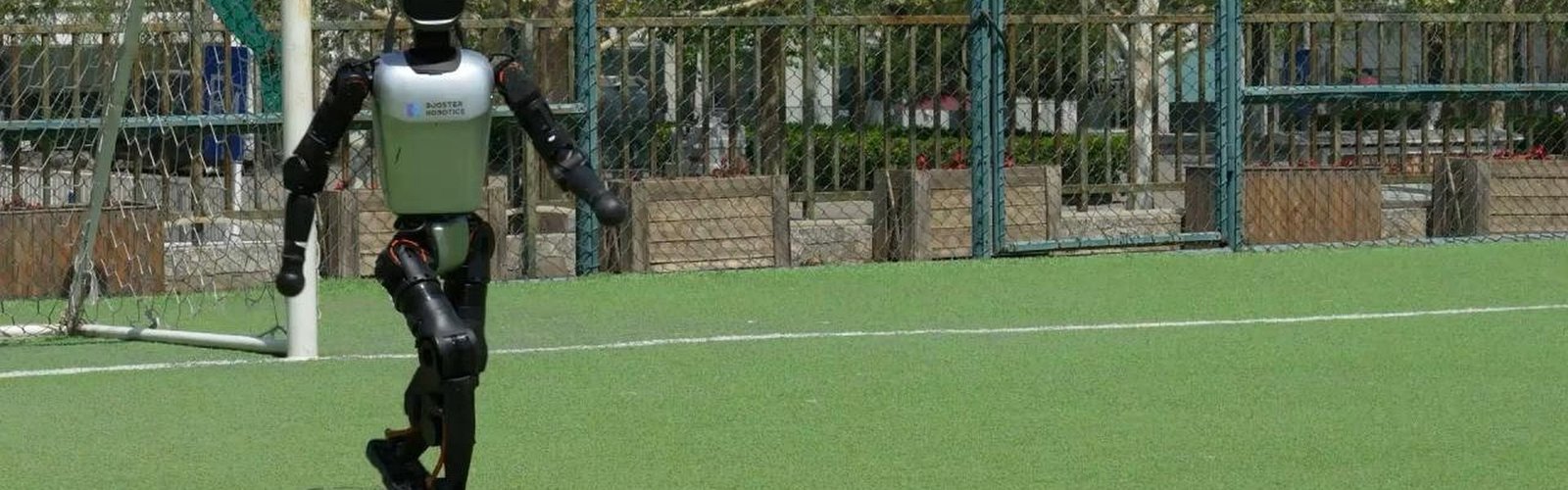
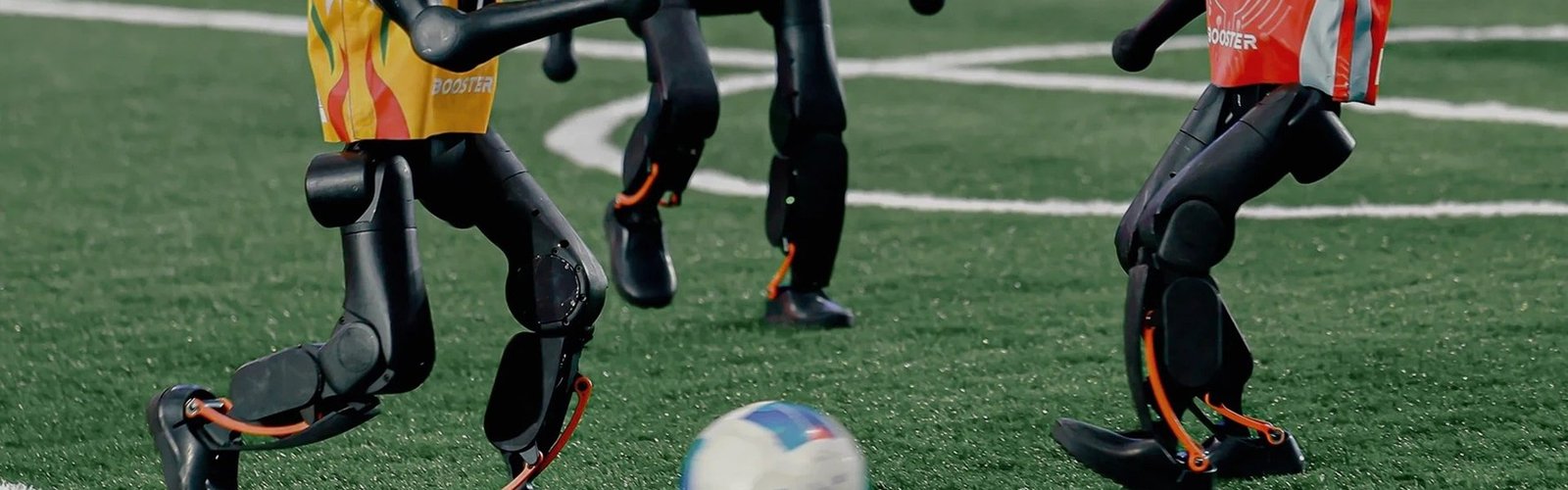
The football events at the World Humanoid Robot Games ended with a clean sweep: Booster-powered entries took the football medals, completing a season that also brought China's first RoboCup world title in 28 years. For Booster Robotics, the medals matter less as trophies than as evidence. A robotics competition platform is only worth buying if it performs in public, under match pressure, against strong opposition - and that is exactly the test these results represent.
A Medal Table Built on One Platform
The entries that reached the podium were not one-off laboratory prototypes. They competed on the class of developer humanoid platform that Booster sells to universities and schools - the same hardware family as the Booster T1 humanoid robot, with its 23 degrees of freedom, depth camera, 9-axis IMU and on-board AGX Orin compute. That distinction matters to buyers. Competition results earned on exotic, hand-built machines prove very little about the robot a customer will actually receive. Results earned on a production platform, by multiple teams, show that the hardware, the control stack and the training pipeline hold together when nobody can pause the match to debug them.
Why Football Is the Hardest Classroom
Robot soccer compresses almost every hard problem in humanoid robotics into ninety minutes. A player robot must walk dynamically on a surface it does not control, perceive a fast-moving ball and moving opponents, dribble and kick with timing, absorb contact, and - when it falls, as every biped eventually does - get up by itself and rejoin play before the moment passes. There is no teleoperation to hide behind and no second take. This is why Booster treats football as the proving ground for its whole product line: a platform that can survive a season of competitive matches has already demonstrated the locomotion, perception and recovery skills that laboratories and classrooms ask for every day.
Medals Are a By-Product of the Calendar
It is worth noting how unglamorous the winning routine actually is. Medal seasons are built on a training calendar, not on inspiration: policies trained in simulation during the week, verified on the training ground, stress-tested in scrimmages, and reviewed like match footage by engineers and students together. Falls are logged, not hidden. Weak gaits are retrained, not excused. The Games simply made that calendar visible to a wider audience. For Booster, the results close the loop on a founding belief - that a team which trains its robots in public, against real opposition, will always out-develop a team polishing demonstrations in private. The trophies are welcome; the calendar is the asset.
The Toolchain Behind the Teams
Hardware alone does not win medals; the teams also shared a toolchain. Booster's developer tools and RL framework let teams train walking, kicking, dribbling, disturbance rejection and fall-and-get-up policies in simulation, then deploy and verify them on the real robot through a sim-to-real pipeline. Policies can be iterated daily instead of weekly, risky behaviours can be explored in simulation before they ever touch hardware, and a tactic that works in testing on Monday can be running on the pitch by the weekend. When several teams build on the same toolchain, improvements compound: every team's hard-won fix becomes part of a shared, maturing baseline.
What It Means for Your Team
If you are starting or rebuilding a competition team, the practical lesson of this season is to choose the platform and toolchain as one decision. Ask what the platform has won, who else is developing on it, and whether the exact training pipeline used by the winning teams is the one you will receive. Booster's competition programme is built around that transparency: the same robots, the same RL framework and the same sim-to-real workflow are available to every customer team, from first-year university squads to experienced RoboCup campaigns.
Planning a team for the next competition season? Compare the relevant product range and deployment scenarios to take the next step.