
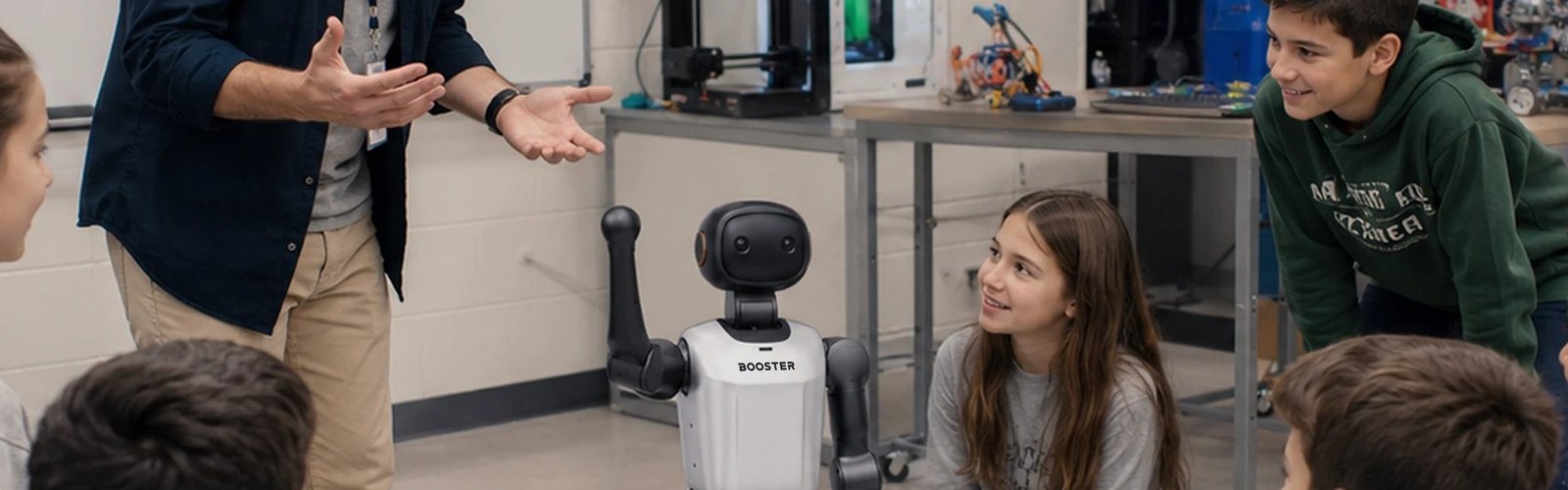
Flagship humanoids are specified for research groups; schools need the same honesty in a smaller frame. The Booster K1 humanoid robot is our compact platform: 0.95 m tall and 19.5 kg, with 22 degrees of freedom, built so that students can work around it, teachers can manage it, and the behaviours it teaches - walking, balance, recovery, perception - are the real ones, not a toy's approximation of them. This article introduces the K1 in detail and explains where it fits between a first STEM lesson and a competition team.
Sized for the Classroom, Not the Showroom
Proportions decide whether a robot belongs in a school. At 0.95 m, the K1 stands at a comfortable working height for students: they can observe joint movement at eye level, gather around it in a group, and connect the code on their screens to motion they can inspect closely. At 19.5 kg it remains a serious machine that staff handle with a defined routine rather than a prop carried under one arm. The K1 product page sets out the full specification; the design intent behind it is a platform that fits classroom furniture, classroom supervision and classroom time.
22 Degrees of Freedom - Real Bipedal Behaviour
The K1's 22 degrees of freedom are the point of the product. This is a true bipedal humanoid: it walks with articulated legs, balances through its joints, plays robot football and demonstrates fall-and-get-up behaviour - the full set of phenomena that make humanoid robotics worth teaching. Students programming the K1 are working on the same categories of problem as university research teams on the flagship T1: gait stability, whole-body coordination, recovery policies. The scale is educational; the subject matter is not diluted, which is exactly why the K1 holds attention across a multi-year programme instead of one exciting week.
Compute and Endurance Matched to Lessons
On-board GPU compute rated at 100-200 TOPS gives the K1 the headroom for perception and policy work at education scale - vision pipelines, behaviour inference and the interaction projects school programmes build. Endurance is specified as 50 minutes of continuous walking, and that figure is published plainly because timetable planning depends on it: a lesson block, a club session or a match run fits inside it, and charging rotation between groups is part of the standard classroom routine our programme materials describe. Honest numbers, again, are a feature - teachers plan around them.
One Platform From First Lesson to Competition
The K1 shares the Booster development approach: the same style of developer tools and reinforcement learning framework, the same simulation-first workflow, scaled to its hardware. That continuity is what connects the K1 to the competitions pathway: a school can begin with structured STEM sessions, progress to project work, and field a robot football team on the same class of platform that contests national and international events. Skills transfer upward to the T1 instead of expiring, which is how an education purchase becomes a programme asset rather than a one-term novelty.
Where the K1 Fits - and Where It Does Not
The K1 is the right platform for schools, training centres and university teaching laboratories whose priority is education and competition at compact scale. Groups whose primary work is advanced locomotion research, or who need the flagship's full compute and expansion headroom, should start from the T1 instead - our comparison article on choosing a research humanoid sets out the criteria in full. What the K1 never asks a school to accept is a lesser subject: it is a real humanoid, teaching real embodied AI, in a size a classroom can run every week.
Building a school or training-centre programme around humanoid robots? Compare the relevant product range and deployment scenarios to take the next step.


