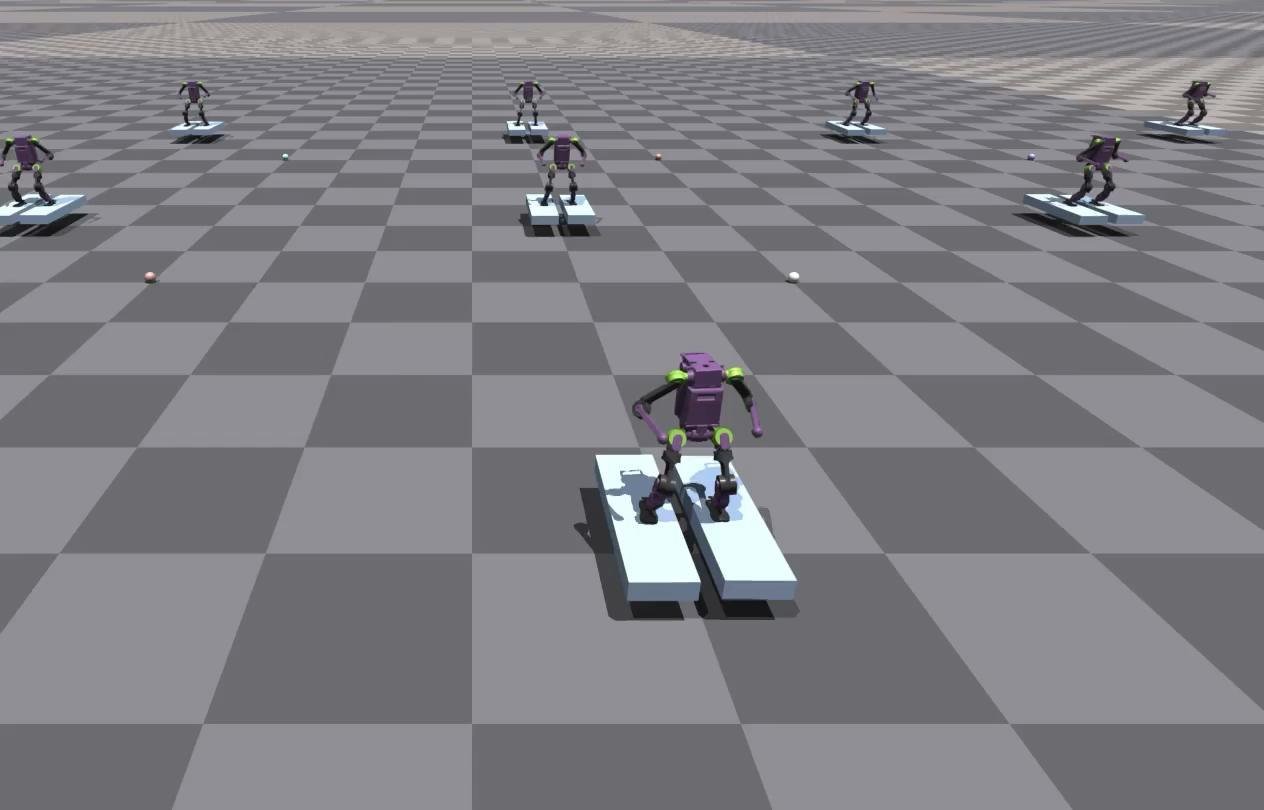

Every product range has a reference point, and for Booster Robotics it is the Booster T1 humanoid robot: the flagship developer platform on which a Chinese university team won the 2025 RoboCup world title - the first for China in 28 years - and the machine at the centre of more than 1,000 robots shipped in 2025. This article sets out the T1 in detail: the body, the compute, the endurance, the senses and the paperwork, so research teams can judge it the way engineers judge any instrument - by what is specified, and by the basis on which it is specified.
The Body: 1.2 Metres, 23 Degrees of Freedom
The T1 product page lists the platform at 1.2 m tall and 30 kg, with 23 degrees of freedom - and the word that matters in that specification is expandable. A fixed DoF count describes the robot as delivered; an expandable architecture describes the robot as a research programme will need it across several years of work. Twenty-three actuated joints give the locomotion and whole-body control research the T1 is built for - walking, turning, kicking, falling and getting up - while expansion headroom protects the investment as projects grow into manipulation and richer upper-body work.
The Brain: 200 TOPS on Board
Developer platforms live or die by their compute, because research code has to run somewhere. The T1 pairs a 14-core CPU with an AGX Orin GPU delivering 200 TOPS of AI compute, on the robot - not in a tethered workstation that turns a mobile platform into a marionette. That headroom is what lets teams run modern perception, policy inference and logging concurrently, and it is why the same platform serves both locomotion groups and embodied AI groups working on vision-language-action research. The specification is stated with its processor named, so buyers can verify exactly what class of compute they are getting.
Endurance, Quoted the Honest Way
Booster publishes the T1's endurance as two figures - 2 hours walking, 4 hours standing - because a single blended number would mislead exactly the people planning experiments around it. A locomotion session, a classroom demonstration and a perception data-collection run draw power at very different rates, and laboratory scheduling is built on the conservative figure for the activity in question. We recommend the same two-number discipline when comparing any humanoid: ask for the walking figure and the standing figure separately, and plan your timetable on the one that matches your work.
Senses: Depth, Balance and Hearing
The standard sensor suite combines a depth camera for spatial perception, a 9-axis IMU for balance and motion state, and a microphone array for voice interaction and sound-source work. It is a deliberately research-oriented set: the depth camera and IMU are the inputs locomotion and navigation policies are built on, and the microphone array opens the human-interaction projects that teaching laboratories increasingly run alongside movement research. Together with the developer tools and RL framework, the suite means a team can start on perception, control and interaction projects from the same base unit.
Certified for the Markets It Ships To
A research robot that cannot legally or safely travel is a local curiosity. The T1 carries CE, FCC, CB, KC, MIC and WPC certifications with UN38.3 for battery transport - the set that underpins Booster's shipments to customers in more than 20 countries, and the detail our certifications page publishes model by model. For universities, that paperwork is not bureaucracy: it is what lets a platform be ordered by a procurement office, insured by an institution and flown to a competition without a special project to clear it.
Full specifications, options and delivery information are on the Booster T1 product page. Compare the relevant product range and deployment scenarios to take the next step.