
A rigid gripper is a bet on geometry: it assumes the object is where the model says, shaped as the model says, and stiff enough to be located by force. Soft, odd-shaped objects break every clause. A duffel bag's handle moves when touched; a backpack's centre of mass hides under straps and zips; a fabric surface offers friction in one direction and slides in another. Grasping them successfully is less about grip strength than about managing uncertainty - approaching so that errors are recoverable, contacting so that the object settles into the grasp rather than escaping it.
Why Soft Objects Defeat Ordinary Grippers
This is why manipulation research has converged on the baggage hall as a benchmark task. The stream is endless, the objects are adversarially varied, and success is binary and countable - the bag is transferred or it is not. A dexterous manipulation robot that survives that stream has demonstrated something general about physical intelligence.
Perceive, Plan, Adapt: The Grasp Pipeline
The pipeline begins in perception: depth vision segments the object from its surroundings and estimates its extent, pose and likely grasp features - handles, straps, rigid corners, flat faces. A grasp planner then scores candidate contact strategies against the object's estimated properties, favouring grasps that remain valid across the estimate's uncertainty rather than optimal for one guessed shape. During execution, force and tactile feedback close the loop: contact is detected, closure adapts to the object's actual compliance, and slip is sensed and corrected in real time.
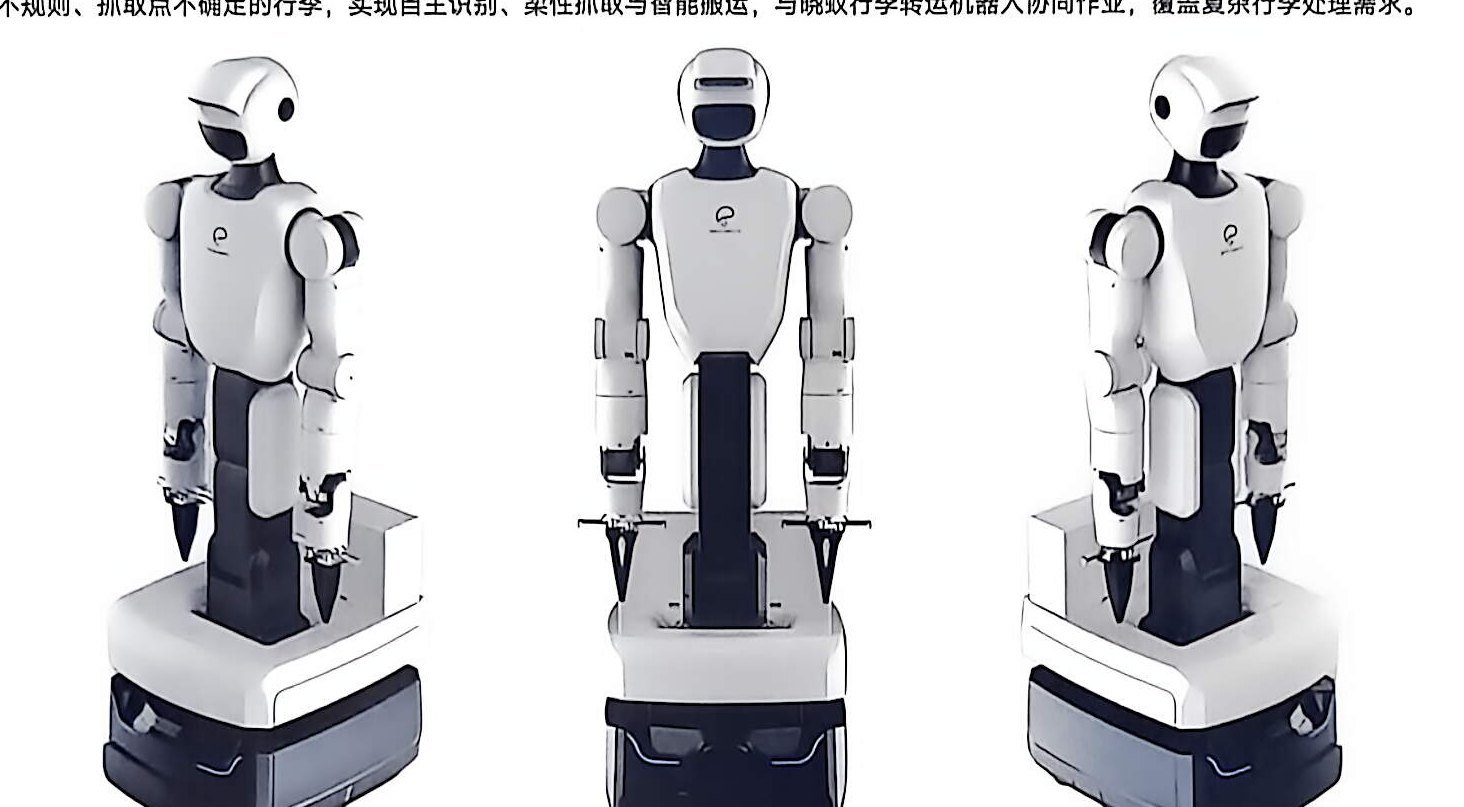
Booster's manipulation stack runs this pipeline under its VTFLA architecture - vision, tactile, force, language and action in one model - so the grasp strategy is informed by every channel at once. The wheeled dual-arm humanoid robot embodies it: two 7-DoF arms, depth-vision navigation, and end effectors chosen for soft, irregular goods, rated at 6 kg on one arm and 12 kg across both.
End Effectors That Forgive
Hardware carries half the intelligence. Suction excels on smooth, sealed surfaces and fails on fabric; parallel grippers are precise on rigid edges and helpless on a strap; enveloping and composite designs trade precision for tolerance. The composite end effector on Booster's DawnAnt baggage transfer robot combines suction and gripping in one tool, selecting the mode per object - and its 240-540 mm gripping range exists precisely because the objects refuse standardisation. The design principle generalises: for soft goods, the end effector should conform first and command second.
Dual arms add the second half of forgiveness. One arm can stabilise while the other grasps, reorient an object to expose a handle, or share a load neither could manage alone - strategies humans use without thinking and robots must be taught deliberately. Bimanual coordination is where the dexterous manipulation robot stops looking like a crane and starts looking like a worker.
Learning Grasps Instead of Programming Them
No engineering team can hand-program grasps for every bag on Earth. Modern manipulation therefore learns: grasp policies are trained across thousands of object variations in simulation, refined against logged real-world successes and failures, and deployed with the confidence measures the policy itself reports. A policy that knows when it is unsure can ask for a second look, a different approach angle, or - in a well-designed system - route the object to the human exception lane rather than dropping it.
That routing decision is a system-level virtue. In Booster's airport collaboration model, roughly 80 percent of the flow is automated transfer, 10 percent is flexible humanoid handling of the irregular stream, and 10 percent remains manual - the design admits that some objects should be handed to people, and makes that hand-off a feature of the line rather than a failure of it.
Judging Dexterity as a Buyer
Evaluate manipulation the way the baggage hall does: by the stream, not the demo. Ask for success rates across an unselected run of objects, watch the failures (do they fail safe, set down, escalate?), and time the recovery behaviour. Check the grip range and payload figures against your heaviest, widest real objects, and ask how new object classes are taught. Dexterity is a statistic earned over volume.