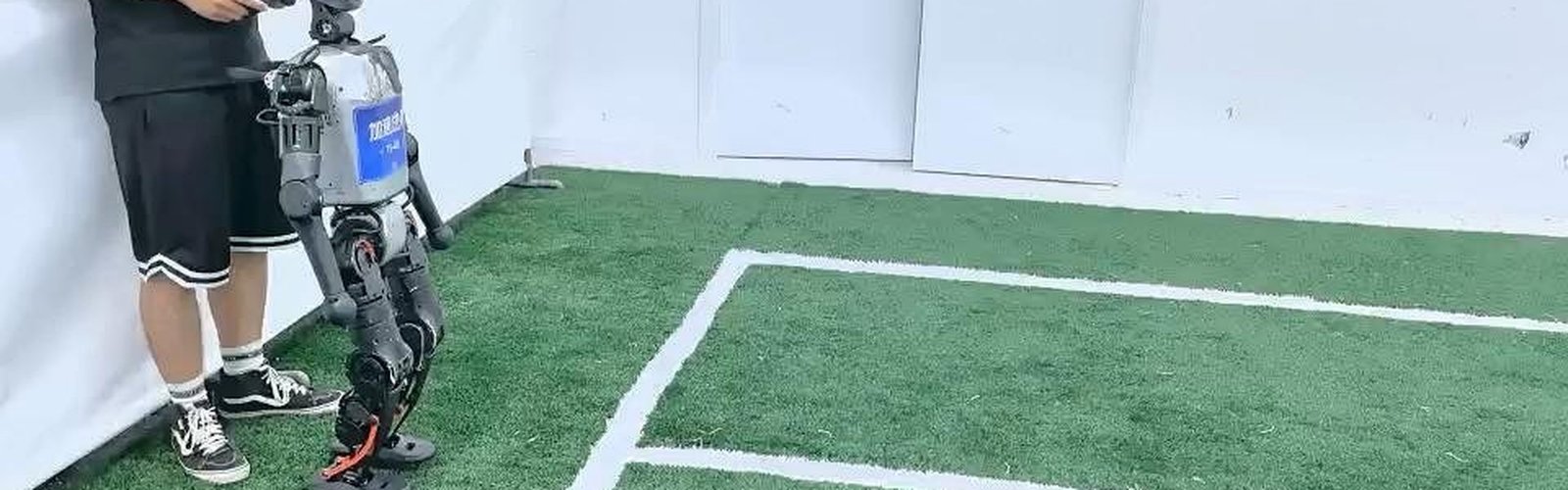

A push does not ask whether the robot was busy. It adds momentum to a system whose entire support is the area under its feet, and the system's options are set by that geometry: absorb the momentum within the current support by shifting pressure and posture, enlarge the support by stepping in the direction of the fall, or - if both fail - go down as gracefully as possible. Disturbance rejection is the engineering of the first two options, executed within a few hundred milliseconds, on disturbances whose size and direction are never announced.
The Physics Nobody Negotiates With
The reason this matters commercially is that real environments push constantly. Students crowd a demonstration, a carried bag snags a door frame, a competition opponent contests the same metre of pitch. A bipedal humanoid robot that treats every contact as an emergency stop is a robot that stops all day; one that absorbs, steps and continues is a tool. The difference is not the motors - it is the estimation and control stack.
Sensing the Push Before It Finishes
Recovery quality is decided by detection latency. The inertial measurement unit senses the body's angular change as the push lands; joint torque sensing feels the unexpected load distribution; foot pressure sensing watches the support forces migrate toward the edge. Fused, these channels tell the controller not just that balance is threatened but how - direction, magnitude, timing - which is what allows a proportionate response: a posture correction for a nudge, a recovery step for a shove, a protective crouch when the disturbance exceeds the step budget.
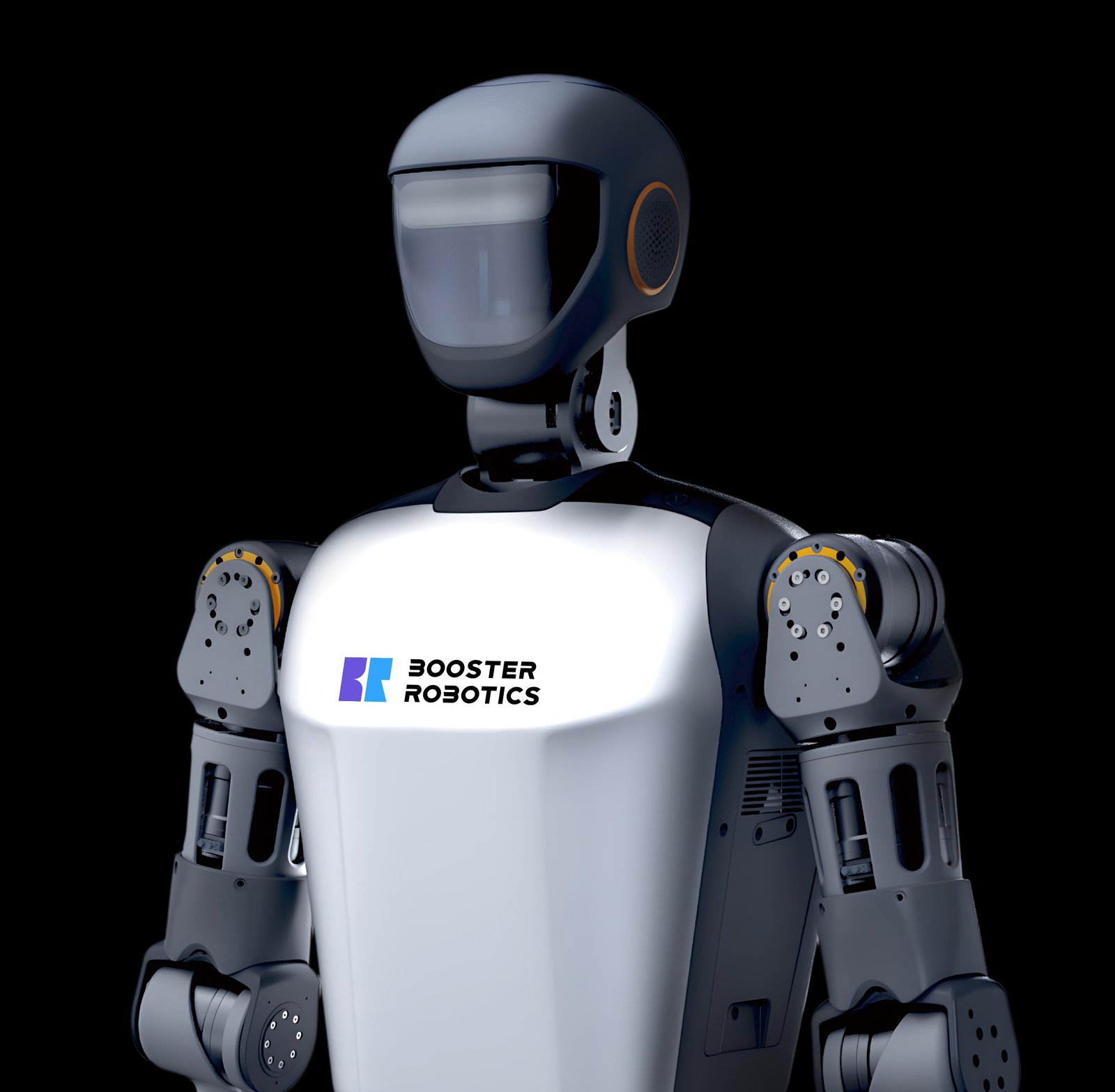
Booster's platforms carry the sensor fit this requires as standard - the T1's sensor suite pairs a 9-axis IMU with depth perception and joint-level feedback across its 23 degrees of freedom - because the founding team's football background made disturbance a design input rather than an edge case. Robots built for the RoboCup pitch are pushed by professionals; the stack that survives that league treats a school corridor's bumps as light weather.
The Recovery Playbook: Ankle, Hip, Step, Arms
Controllers spend recovery options in order of economy. Small disturbances are absorbed at the ankle and by pressure redistribution - the cheapest correction, invisible to an observer. Larger ones recruit the hip and torso: angular momentum is traded against posture, the body's mass is thrown briefly against the fall to buy time. When the disturbance pushes the capture point beyond the feet, the controller steps - placing a foot under the falling momentum, sometimes crossing, sometimes widening, converting a fall into an unplanned but ordinary walking step. Arms participate throughout, swinging to manage angular momentum exactly as a person's do.
Learned policies have enriched this playbook beyond what hand-tuned controllers attempted: reinforcement learning in simulation exposes the robot to thousands of pushes from every direction and magnitude, and the policies that emerge mix strategies fluidly - a half-step with a torso twist, a stumble that becomes a turn. Booster trains and verifies these behaviours through the same sim-to-real technology pipeline behind its competition results, and ships them as part of the platform, not as a laboratory curiosity.
Disturbance Rejection Is a Team Sport
On the competition field, disturbance rejection stops being a solo skill. A football humanoid is pushed while tracking a moving ball, mid-kick, with teammates and opponents constraining where a recovery step may land. The controller must reject the disturbance without fouling, without leaving its tactical position entirely, and be ready to play the next ball in the same second. This is the audit environment that produced Booster's 2025 RoboCup world title - and the reason our robotics competitions solution presents recovery under contact as the core competency a new team is really buying.
Research laboratories feel the same physics at lower speed. A humanoid carrying an instrument across a shared lab, bumped by a passing trolley, either absorbs the event or drops the instrument and the afternoon. Disturbance margins are experiment insurance, priced into every hour the robot works among people.
How to Judge It in a Demonstration
Push the robot - properly, with the supplier's permission and on your own floor. Vary the direction: front, back, and the revealing one, from the side while it stands on one foot mid-step. Push it while it carries something. Watch three things: whether the response is proportionate or theatrical, how many steps recovery costs and where they land, and how quickly the robot returns to its task rather than standing in a defensive pose. A mature bipedal humanoid robot treats your push as weather.