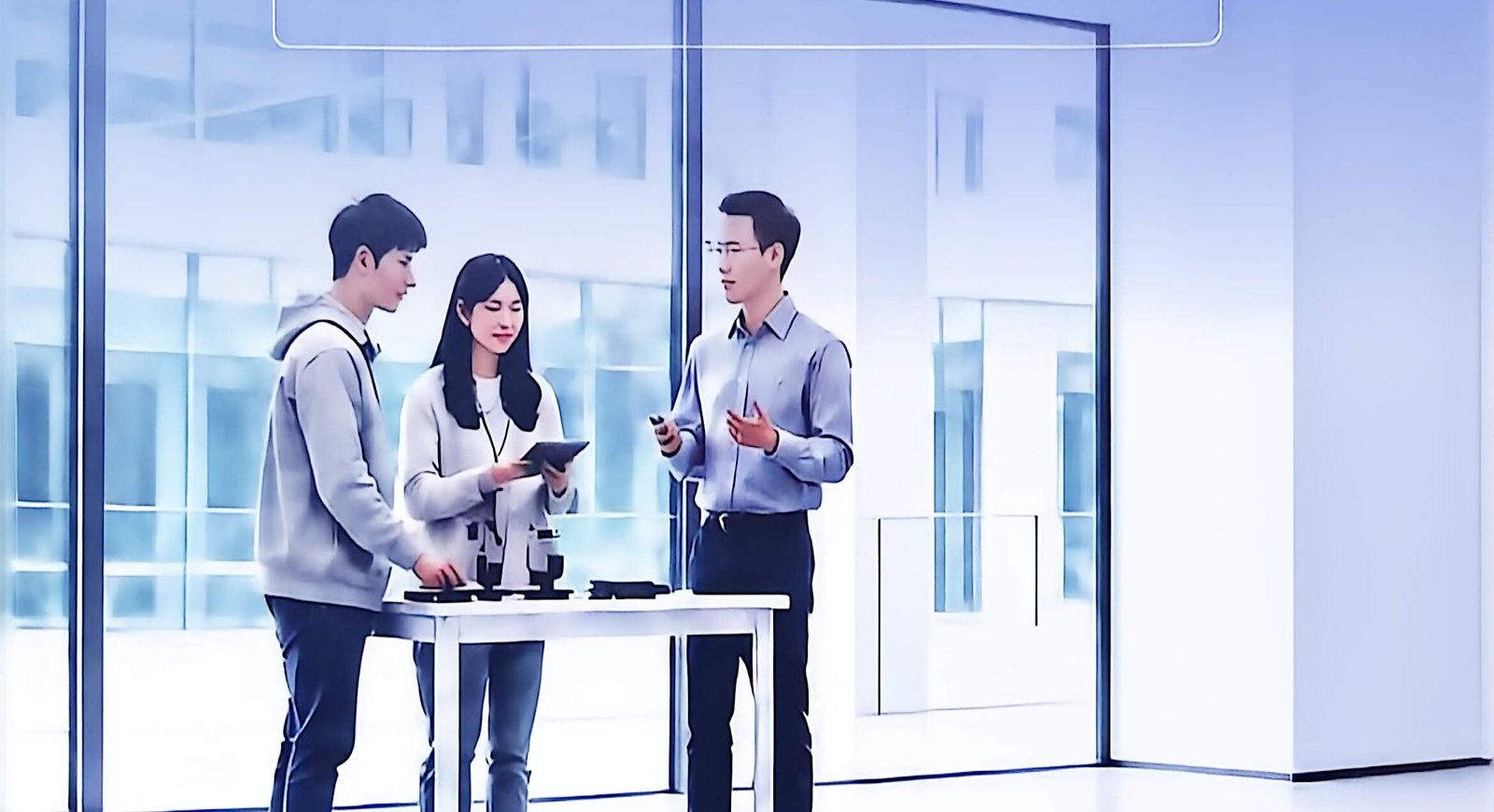
Education exhibitions have a simple credibility test: put the robot in front of students and see what happens. Booster Robotics builds its education expo presence around that test, presenting an AI education robot solution that runs live - humanoid robots walking, recovering from falls and playing robot football in a classroom-style setting rather than standing behind glass. This article gathers the highlights visitors responded to, and the practical questions teachers, school leaders and distributors asked once the demonstrations ended and the buying conversation began.
A Compact Humanoid at Student Height
The centre of the classroom demonstrations is the Booster K1, a 0.95 m humanoid that stands at a comfortable working height for school students rather than towering over them. At 19.5 kg with 22 degrees of freedom, it is a real bipedal research-class machine scaled for education: students can gather around it, watch joints articulate at close range and connect the movement they see to the code they wrote. Expo visitors consistently spent longer at the K1 than at larger platforms, because it invites the question every good lesson needs - what happens if we change this parameter?
Robot Football as the Doorway In
The busiest corner of the stand is always the football pitch. Robot soccer compresses the whole embodied AI curriculum into one visible game: perception to find the ball, decision-making to choose a play, locomotion to execute it, and recovery when a robot falls - which, in front of a crowd of students, it reliably does, to the loudest cheer of the session. Booster's football heritage runs from the Tsinghua Vulcan team through the 2025 RoboCup world title, and the competitions pathway shown at the expo connects a school's first classroom robot to a team competing at national and international level.
The Questions Teachers Actually Ask
Once the demonstrations end, teachers ask operational questions, and the expo format lets us answer them with the hardware in reach. How is a class managed around a walking robot - working zones, student roles, one robot per group or per class? What does the timetable integration look like inside a structured K-12 and STEM programme, rather than a one-off enrichment day? How are falls, collisions and excited students handled safely? And what do students take away that a certificate or competition result can recognise? These are the right questions, and a credible education supplier should welcome every one of them on the stand.
From Showcase Lesson to Programme
The gap between an exciting demo and a working programme is curriculum, teacher preparation and progression. The Booster education solution is structured to close that gap: age-appropriate entry points for younger students, project-based work for older ones, teacher training so staff can run sessions without a vendor engineer in the room, and competition milestones that give each term a target. At the expo we walk school leaders through that structure with the robots running beside us, because the claim we are making is not that a humanoid is impressive for one afternoon - it is that it can carry a multi-year STEM programme.
What Distributors and Partners Look For
Education exhibitions also serve the channel. Distributors evaluating an education robot line look for demonstration reliability - a robot that performs all day, every day of a show, on the shipped software - plus training materials, local-language teaching resources and a support model they can stand behind in schools. Booster's education line is delivered with the laboratory and programme services behind it, and the partner conversations at recent expos have centred on exactly that: not the robot alone, but the robot plus curriculum plus training as one sellable, supportable package for their market.
Compare the relevant product range and deployment scenarios to take the next step.