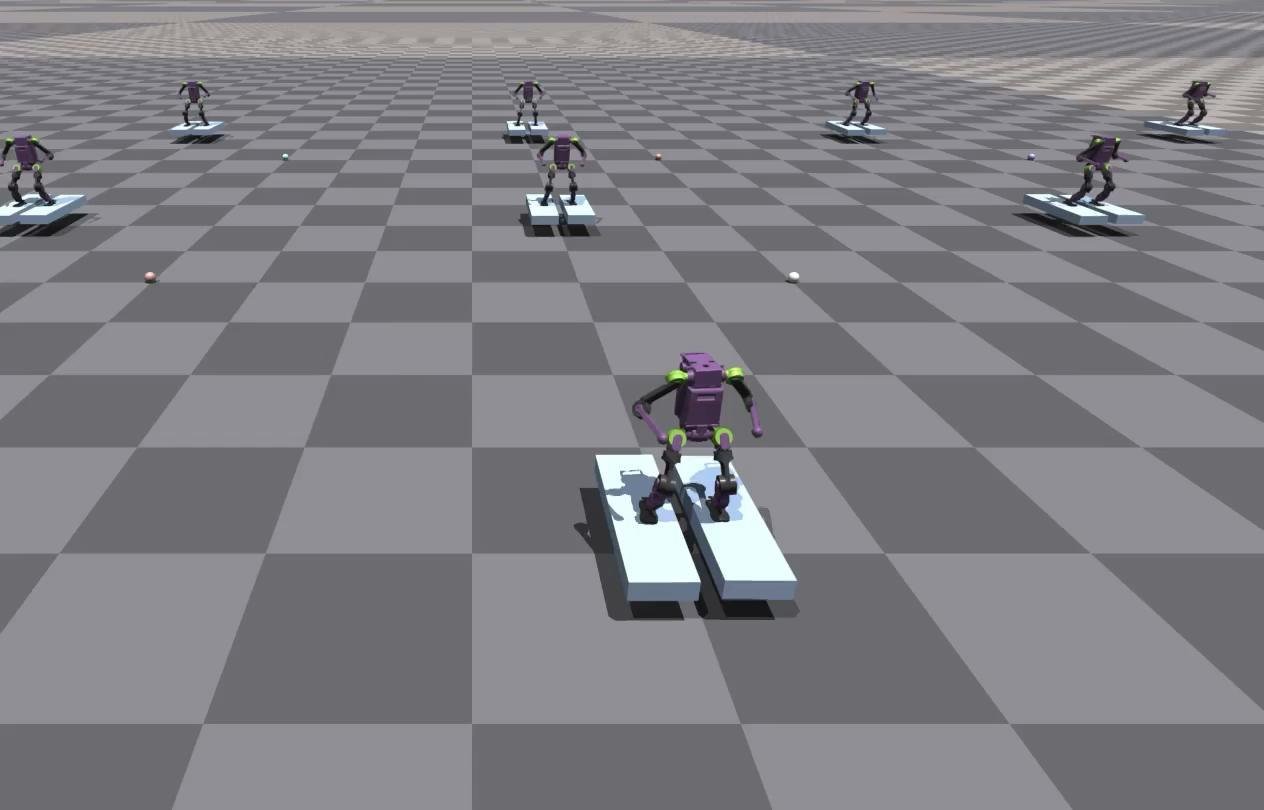

Embodied AI is intelligence that acts through a physical body - perceiving, deciding and moving in the real world rather than only processing data. A robot is embodied when its decisions are closed through sensors and actuators in a physical loop. The humanoid form factor copies the human body's layout - two legs, two arms, a head - to work in spaces built for people. A quadruped uses four legs for terrain independence; a wheeled-legged robot hybrids wheels and legs for efficiency plus obstacle ability. Degrees of freedom (DoF) count independently controlled joints - the T1's 23, expandable, against the K1's 22 - and bound the motions a platform can perform. Prompt question for any brochure: which of these terms describe the machine, and which describe the marketing?
Foundations: The Words on the Cover
Intelligence: Models and Training
A Vision-Language-Action (VLA) model converts camera input and language instructions directly into robot actions; Booster's VTFLA architecture extends the pattern with tactile and force channels, detailed on our VTFLA architecture page. Reinforcement learning (RL) trains behaviour policies by reward across millions of simulated trials. Sim-to-real is the transfer discipline that makes those policies work on hardware despite simulation's inaccuracies; a policy is the trained behaviour itself, versioned and deployed like software. TOPS rates on-board AI compute throughput - the T1's AGX Orin module is rated at 200 TOPS - and matters only alongside the question of what runs on it. SLAM (simultaneous localisation and mapping) is how a robot builds a map while placing itself inside it; embodied navigation builds on SLAM to plan and execute routes in 3D space.
Body: Control and Recovery
Whole-body control coordinates every joint under one balance-first hierarchy, instead of running legs and arms as separate machines. Disturbance rejection is the measured ability to absorb pushes and disruptions without falling; fall recovery is the companion skill of returning to standing unaided afterwards. Quasi-direct-drive actuators - low gear-ratio, back-drivable joint motors - give humanoid joints their compliant, force-transparent character. Dexterous manipulation names the perception-and-grasp discipline for objects that resist standard gripping; force control is its regulatory core, holding firmly without damaging. End effectors are the tools at an arm's end - grippers, suction, or composites like DawnAnt's suction-and-gripper unit. Each of these terms corresponds to a demonstrable test; the glossary's rule is that a term you cannot test is a term you should not pay for.
Operations: Fleets and Platforms
A developer platform is a robot sold as a foundation for others' work - SDK, documentation and tools included; the SDK itself is the software kit those developers build against. A simulation platform hosts the virtual half of the training loop, ideally paired with a physical training ground for verification. At fleet scale, multi-robot scheduling assigns work across units; fleet management software tracks state, health and history; and traceability is the per-item record - every bag, every reading - that regulated operations require. Payload names both a carried sensor package and its mass budget, the currency payload planning spends. Buyers should ask which platform layers are included in a quotation and which are roadmap; the distinction has sunk more programmes than any motor.
Using This Glossary in a Live Evaluation
Take the terms back to the demonstration floor. Ask the supplier to show the policy version running the robot, the sim-to-real evidence behind it, the disturbance test, the recovery, the fleet view. Ask what the end effector's grip range is, in millimetres, against your widest object - DawnAnt's is 240-540 mm, published, because real terms survive publication. Embodied AI purchasing rewards buyers who treat vocabulary as a checklist of verifiable claims, and this archive's explainers - linked from our technology pages - exist to make each claim checkable.