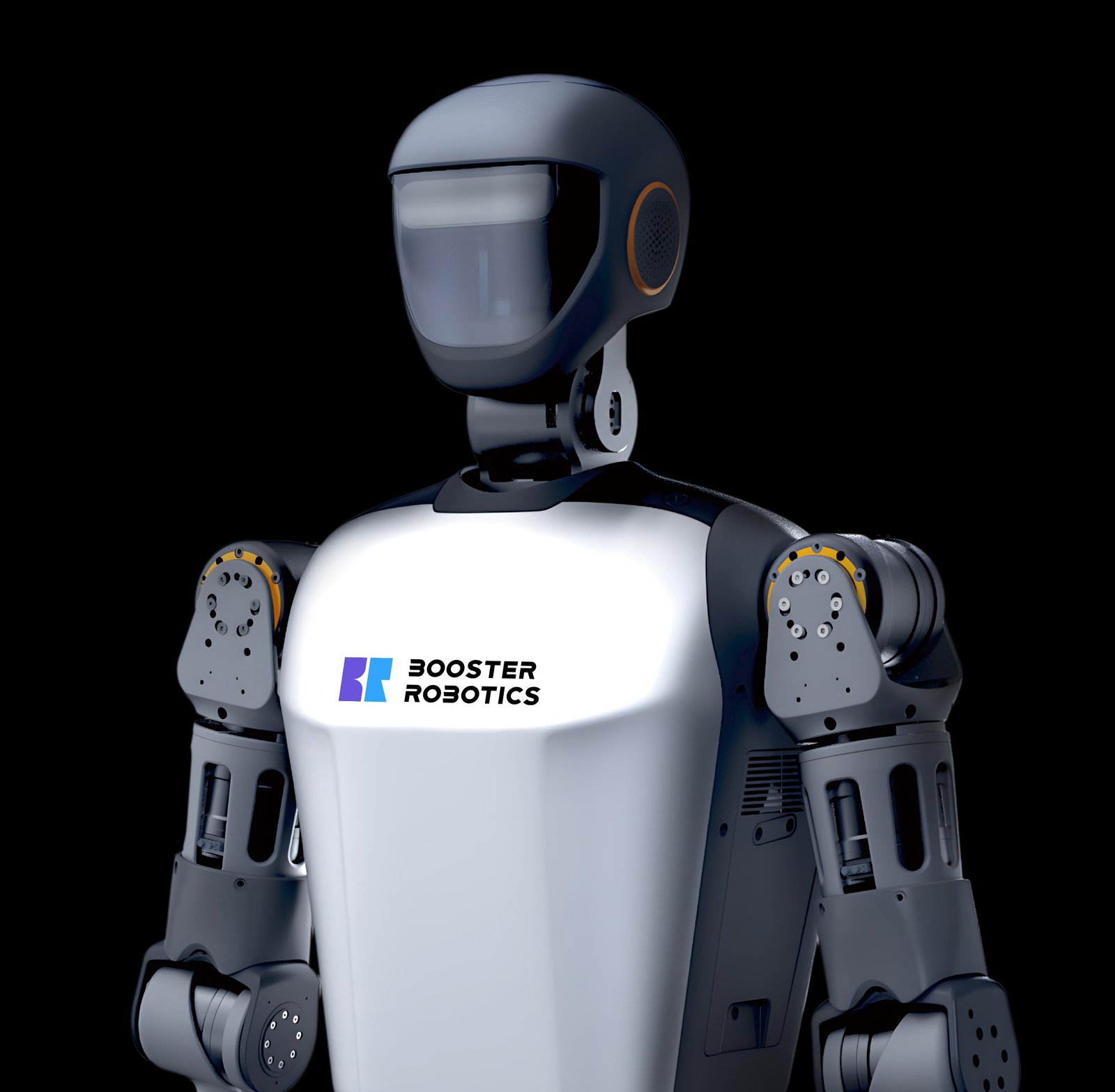

Open a humanoid specification and the senses compress into one line: depth camera, 9-axis IMU, microphone array. Those three phrases carry most of what the robot can perceive, and they divide the perceptual world between them with almost no overlap. This tour of humanoid robot sensors takes each in turn - what it measures, what it enables, what fails without it - using the Booster T1 humanoid robot's verified fit as the working example.
The Depth Camera: The World in Three Dimensions
A depth camera does what an ordinary camera cannot: it reports distance per pixel, turning a picture into a measured scene. The humanoid uses it to find the ball on a football pitch, the edge of a step, the handle of a bag, the face it is addressing - each with a position in space, ready for a planner or a learned policy to act on. Depth sensing is the input channel for manipulation and navigation alike; its limits - range, bright sunlight, transparent and mirror surfaces - are the classic ones, and serious platforms fuse it with other sensing rather than trusting it alone.
The 9-Axis IMU: Balance Lives Here
The inertial measurement unit is the sensor laypeople overlook and engineers ask about first. Nine axes means three each of accelerometer, gyroscope and magnetometer: linear acceleration, rotation and heading, fused into a continuous estimate of the body's orientation and motion. A walking humanoid is an inverted pendulum solving balance many times per second, and the IMU is its inner ear - the feedback that says the torso is pitching, the landing foot struck early, the push from the crowd is arriving now. Remove the depth camera and the robot is blind; remove the IMU and it is on the floor. When evaluating any biped, the quality of this unglamorous block predicts the quality of the walking more honestly than the headline degrees of freedom.
The Microphone Array: Hearing With Direction
One microphone hears sound; an array hears where sound comes from. By comparing arrival times across its elements, a microphone array localises a voice, focuses on the speaker against room noise, and gives the robot the social basics - turn toward the person addressing it, pick a command out of a busy lab, register the whistle that starts the match. In education and service settings this is the channel that makes interaction feel like interaction, and it feeds the language side of the wider embodied AI technology stack: speech recognised with direction and confidence, not just volume.
How the Three Divide the Work
Notice the pattern: the depth camera owns the external geometry, the IMU owns the self, the microphone array owns the social channel. Walking uses all three in sequence - IMU keeping the body upright at control-loop speed, depth camera updating the world's model at perception speed, microphones listening at human speed. Sensor questions in a procurement should follow the same division: camera range and performance in your lighting; IMU and fusion quality, best judged by watching disturbance recovery live; array performance in your room's actual noise. Demonstrations that walk the robot across a quiet, empty, well-lit stage are testing the easiest third of each sensor.
Why This Line of the Spec Sheet Matters
Motors and compute date quickly; a platform's sensing defines what software can ever achieve on it, because no policy recovers information the sensors never captured. When comparing humanoids, read the sensor line as a promise about the ceiling - and then ask the supplier to demonstrate near that ceiling: a push recovered, a voice found in noise, an object located in clutter. The T1's fit was specified for exactly those demonstrations, on pitches and in laboratories rather than on stages.
Comparing humanoid platforms for a lab or competition programme? Compare the relevant product range and deployment scenarios to take the next step.