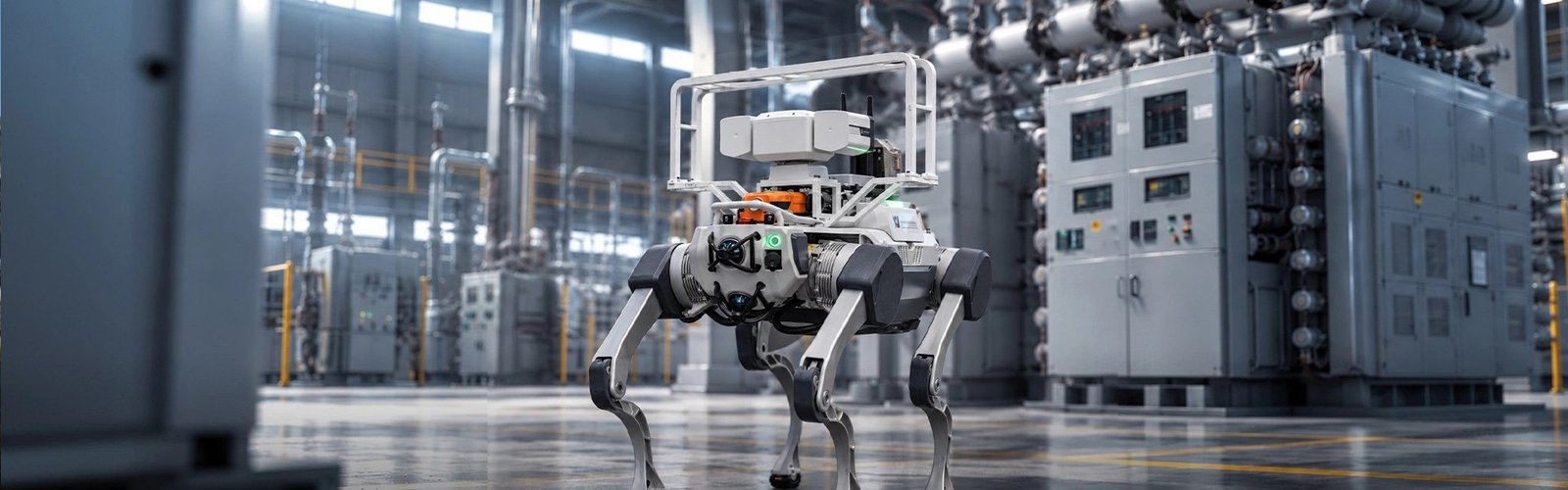
An industrial quadruped robot earns its credibility the same way at a fair as it does on site: by working a route, carrying its payloads and finishing the job in front of witnesses. Booster Robotics' industry fair demonstrations are built around the Jueying X30, the flagship of our quadruped line, running live inspection scenarios rather than posing on a plinth. This article describes what the X30 demonstrates on the stand, how the scenarios map to real deployments, and the questions that power, emergency-services and industrial maintenance visitors asked most.
A Patrol Route, Not a Parade Lap
The demonstration is structured as an inspection round. The Jueying X30 works a marked route between inspection points, pausing at each to acquire readings with its payload - the same rhythm it would follow around switchgear, plant equipment or a facility perimeter. Visitors can watch the navigation behaviour up close: how the robot plans around obstacles placed on the route, how it re-acquires its path when a person steps across it, and how the round is reported back to the operator view. A parade lap shows locomotion; a patrol route shows a product.
Payloads You Can Specify and Swap
Inspection value lives in the payload, so the stand presents the X30 with the options an operator would actually order from our payloads and accessories range: cameras for visual rounds, LiDAR for mapping and navigation in complex spaces, a dual-spectrum gimbal that combines visible light with thermal imaging for heat anomalies, and further sensors for site-specific readings. The fair conversation is practical: which payload answers which inspection task, what the data looks like when it arrives, and how payload choices change between a power facility, a fire-service reconnaissance role and a factory maintenance round.
Scenarios Drawn From Real Deployments
Each fair scenario is drawn from the industrial inspection and public safety solutions Booster delivers: scheduled patrols for the power sector, reconnaissance ahead of human entry for emergency and firefighting teams, routine operation-and-maintenance rounds in industrial plants, and security patrol for campuses and public facilities. Visitors from each sector tend to interrogate a different detail - power teams ask about reading capture at fixed points, fire-service visitors about operating ahead of entry teams, plant engineers about integrating rounds with existing maintenance schedules. The demo is staffed to have those conversations at the level of the deployment, not the brochure.
Terrain, Honestly Presented
Quadruped locomotion invites exaggeration, so the stand includes the unglamorous surfaces too: cable ramps, thresholds, gratings and the transitions between floor types that real facilities are made of. Watching the X30 handle ordinary industrial flooring at working pace tells an experienced facilities engineer more than any staircase stunt. Where a visitor's site presents harsher ground - outdoor yards, gravel, wet surfaces - the honest route is a site conversation and, where needed, the wheeled-legged alternatives in our range, which trade some obstacle ability for rolling efficiency on smoother routes.
From Fair Floor to First Site Survey
The meetings that matter at industry fairs start after the demo. Booster's team uses them to sketch the visitor's actual route: its length, its inspection points, the readings required, the hours of operation and the acceptance criteria a pilot would be judged against. That sketch becomes the basis for a site survey and a scoped pilot proposal, so a fair conversation converts into an engineering plan rather than a exchanged card. Visitors who arrived with photographs and route plans of their own facilities consistently got the most from the stand - a habit we recommend to anyone evaluating inspection robots, ours or anyone else's.
Evaluating quadruped inspection for a power facility, plant or campus? Compare the relevant product range and deployment scenarios to take the next step.