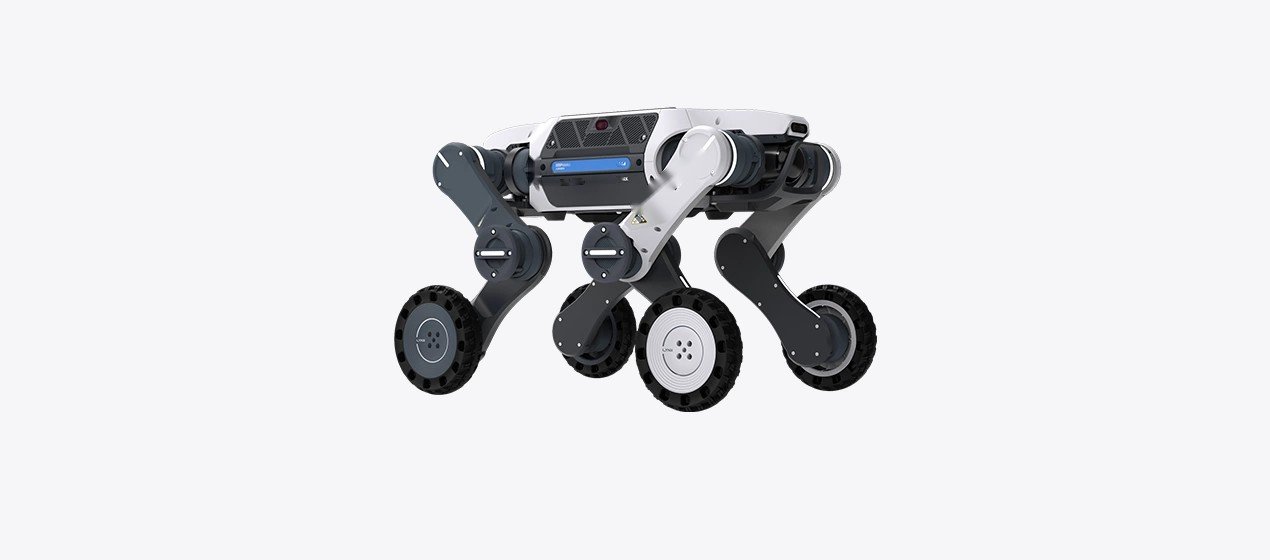

Most workplaces are neither a clean warehouse floor nor a mountain trail - they are both, connected by a kerb, a cable ramp and a flight of site steps. The Lynx M20S wheeled-legged robot is built for that reality: a hybrid platform that rolls where rolling is efficient and uses its legs where wheels alone would stop, carrying a payload class that steps up from the compact end of the range - the Lynx line describes the M20S's upgrade in payload terms as a doubled payload class over its predecessor class. This article explains the platform's role and applications.
Hybrid Mobility, Working Definition
A wheeled-legged robot carries wheels at the ends of articulated legs. On prepared ground it drives, gaining the speed and energy efficiency of wheels; at an obstacle - a step, a threshold, rough ground - the legs articulate to step, lift or stabilise over it. The M20S is the working expression of that idea in our Lynx series: one platform for mixed routes, instead of a wheeled robot that must avoid obstacles and a legged robot that pays a locomotion cost on every flat metre of a long route.
The Payload Step-Up
Mobility only matters if the machine can carry the job. The M20S's positioning in the Lynx line is defined by its payload class: a step up that lets the platform carry the heavier inspection and field payloads - instrument fits, sensor packages, carried equipment - that compact scouts cannot. Detailed numeric specifications are issued with configuration documentation, and the M20S product page marks the fields accordingly; the evaluation point available today is the class itself, and what that class unlocks: fewer compromises between the route a site demands and the instruments a task requires.
Where the M20S Works
The platform's natural work is the mixed-terrain round: industrial sites where a patrol crosses yards, ramps and plant floors in one route; infrastructure inspections where access paths alternate between road surface and rough ground; field operations where a team needs a mobile platform that keeps moving when the prepared surface ends. In the industrial inspection solutions these routes are the ones that used to force a choice - send the wheeled robot and accept its limits, or send people. Hybrid mobility is the third answer, and the M20S is the heavy lifter of that answer in our range.
M20S and S10: One Fleet, Two Sizes
The Lynx series pairs the M20S with the compact S10. The pattern mirrors the quadruped line: compact units for scouting, teaching and lighter routes; the M20S where payload and terrain demands rise. A facilities or laboratory programme can therefore standardise on one mobility concept across sizes, with operating skills and route-planning practice transferring between them. Choosing between them is a route-and-payload question - which is precisely the conversation our team scopes before quoting, rather than a catalogue decision.
Evaluating a Wheeled-Legged Platform
Three questions sort buyers quickly. First, what fraction of your route is genuinely rough - if the answer is nearly none, a wheeled platform may serve you more cheaply; if it is nearly all, a pure quadruped is the honest tool. Second, what must the platform carry at the far end of the route - the payload class decides the model. Third, what does the route cost you today in staff time and missed coverage? The M20S exists for the large middle ground those questions reveal: mixed routes, real payloads, and rounds that deserve automating properly.
Working a mixed-terrain route today with people and clipboards? Compare the relevant product range and deployment scenarios to take the next step.