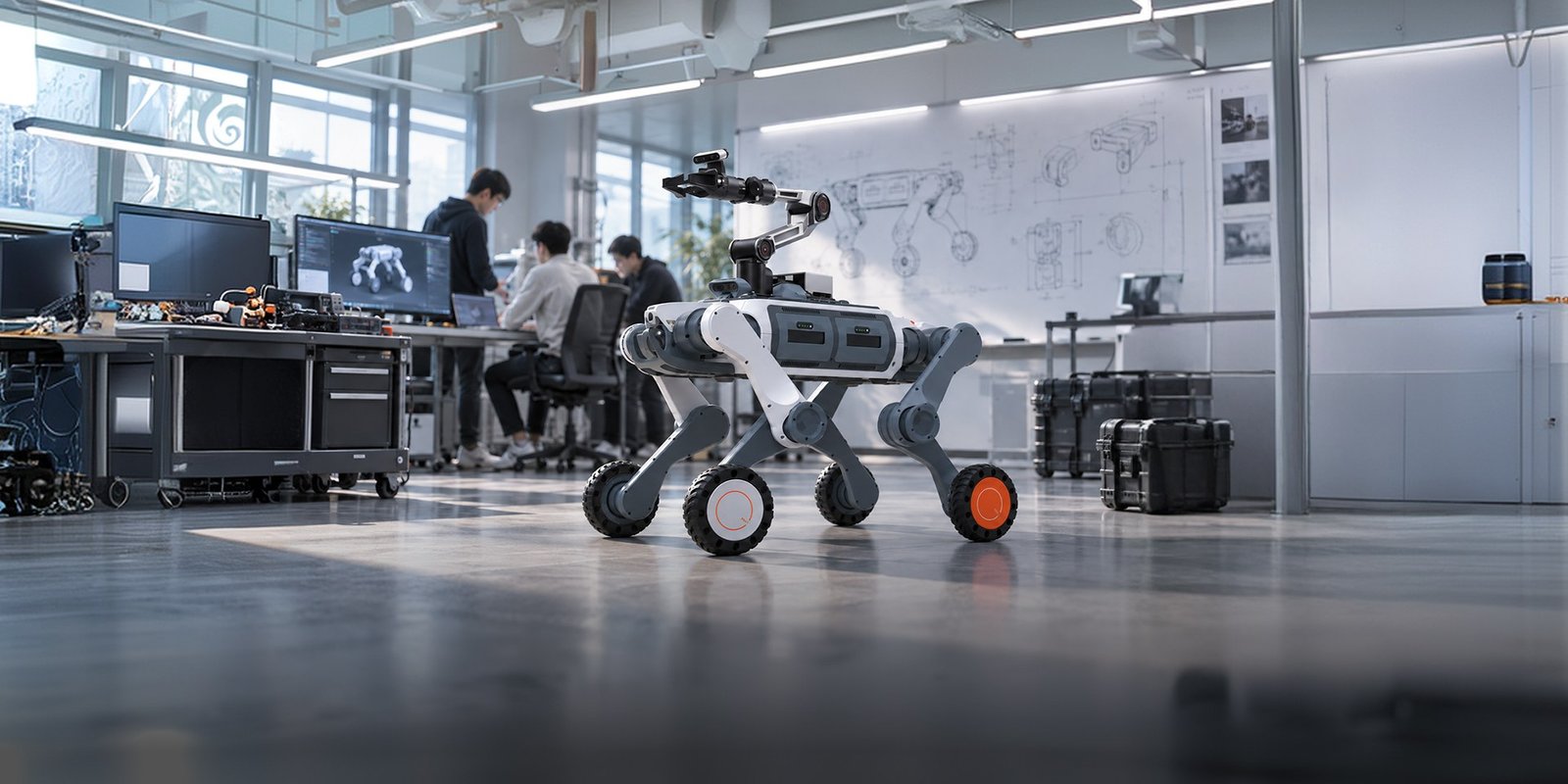

A single robot doing a single job needs no management. The moment a site runs several machines - transfer robots on parallel links, a humanoid roaming between them, units rotating through charging - somebody has to decide, continuously, who does what next. In a robot fleet that somebody is software: a multi-robot coordination platform that schedules work across every unit. This article explains what the platform actually decides, why those decisions are harder than they look, and how to evaluate one.
The Problem: Tasks, Machines and a Moving World
Scheduling sounds static - a timetable - until the world moves. Flights land early; a cart arrives half full; a robot reports a grip fault and needs to retire; a peak bank doubles the arrival rate for forty minutes. The platform's real job is re-deciding under change: which pending task matters most now, which robot is positioned and charged to take it, and what the second-order effects are on the other links. In baggage handling, Booster's multi-robot scheduling platform runs this loop across transfer robots and the flexible humanoid layer, holding the 80/10/10 division of labour as conditions shift rather than as a fixed assignment.
Arbitrating Shared Space
Fleets share floor. Two robots wanting the same aisle, the same cart position, the same charging point is a resource conflict, and unmanaged fleets resolve conflicts the expensive way - by waiting, or by stopping. The coordination layer owns the map and the reservations: paths are booked, priorities at choke points are rules rather than negotiations, and a unit that must yield does so early and smoothly instead of in an emergency stop. Buyers should watch for this in demonstrations: a fleet demo where machines politely queue and reroute is showing you the scheduling layer, and it is the part that determines real-world throughput.
Energy Is a Scheduling Constraint
Battery state turns scheduling into resource management. A platform that assigns purely by distance will strand a low unit mid-peak; a good one rotates machines through charging during lulls, keeps a reserve margin for surges, and weighs a task's energy cost against the unit's remaining shift. The same logic extends to maintenance: hours and cycle counts per unit, balanced across the fleet so no single robot wears out early, with service windows scheduled into quiet periods rather than discovered during failures. Fleet operators feel this most at shift changes, when the platform rather than a supervisor decides which units are ready for the next bank.
The Operator's View
All of this machinery exists to give one human supervisor a calm screen. The operator needs the fleet state at a glance - who is working, who is charging, who is faulted and why - the task queue with its priorities, and exceptions surfaced as decisions, not alarms: this cart is waiting, this bag type is spiking, this link is falling behind. If running the fleet needs an engineer watching logs, the platform has failed its purpose, whatever its algorithms achieve.
Testing a Scheduling Platform
Demonstrations run at the supplier's chosen tempo; your evaluation should not. Ask for: a unit disabled mid-flow - does work rebalance without manual re-planning? A surge injected - how does the queue behave? Two units contesting one position - who yields, by what rule? A charge rotation during your busiest simulated hour. The airport baggage transfer solution evaluations we run with airports are built around exactly these disruptions, because a scheduling platform earns its keep on the worst ten minutes of the day, not the average.
Planning a multi-robot deployment - baggage, patrol or inspection? Compare the relevant product range and deployment scenarios to take the next step.