Incident statistics and insurance files tell the same story from different sides: the hours between roughly midnight and dawn concentrate intrusion, vandalism, undetected leaks and fires discovered late. They are also the hours when staffing is thinnest, fatigue is deepest and a single guard's round leaves the longest unwatched gaps. A camera network covers fixed points continuously but observes nothing between them and judges nothing at all - it records incidents for later review more reliably than it interrupts them.
The Quiet Hours Are the Exposure
A security patrol robot is built for exactly this geometry: mobile, so the gaps between cameras close; scheduled, so coverage does not depend on stamina; and analytical, so what it sees is triaged as it happens. The robot does not sleep, does not skip the far corner in the rain, and walks the same route at 3 a.m. with the same attention it had at midnight.
The Night Round, Designed
A night patrol programme is a rota before it is a robot. Rounds are scheduled against the site's risk rhythm - perimeter checks at randomised intervals within set windows, plant-room and storage checks at fixed points, lighting and access verification as part of the route. Between rounds the robot returns to its station; across the night the coverage compounds. Randomisation inside the schedule matters: a patrol whose timing can be learned from outside the fence is a patrol whose gaps can be scheduled by the people it exists to deter.
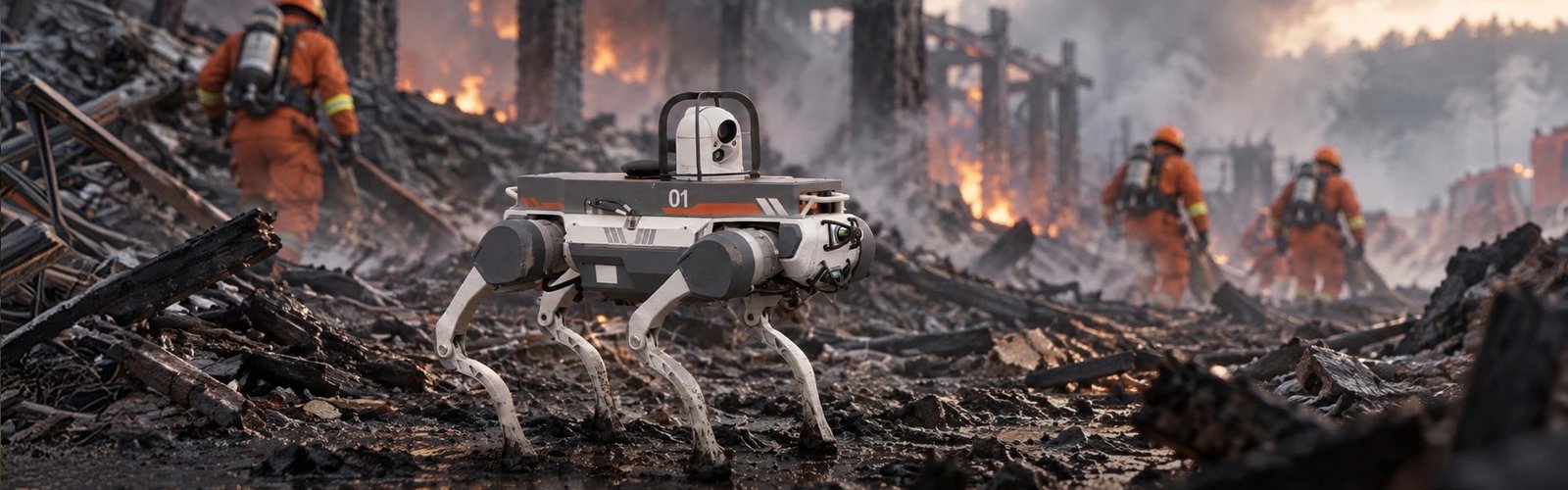
Booster's campus patrol deployments - a flagship quadruped with an embodied navigation system working scheduled rounds at a partner university - run this pattern in service today, under our industrial inspection and public safety solution. The platform fit pairs visual and thermal sensing, because the night round's whole point is to see in the conditions the night provides.
Detection and Escalation: The Robot Finds, Humans Decide
The division of labour is absolute and it is what makes the system deployable: the robot detects and escalates; humans judge and respond. Behaviour analysis maintains the baseline of the quiet site - which makes the abnormal stand out sharply at night, when legitimate activity is rare - and every alert arrives with imagery, position and context packaged for a decision. The on-call guard or control room verifies, dispatches or dismisses, and the robot can be directed to re-observe or hold position while response travels.
This architecture keeps night patrol honest. The robot is not claimed to apprehend anyone, assess intent or replace the judgement call; it guarantees that the call gets made, early, with evidence. Sites measuring pilot programmes should count exactly that: time from event to human awareness, compared against the previous arrangement. It is the metric night patrol exists to move.
Limits Written Down in Advance
Weather narrows the envelope - heavy rain and ice define no-go conditions that a credible programme writes into the rota rather than discovering. A single robot cannot be everywhere, so coverage claims must be stated as round frequencies per zone, not as continuous presence. And the robot's own security matters: tamper detection, location reporting and a lost-unit procedure belong in the deployment plan. None of this diminishes the concept; it is simply the difference between a security system and a security story.
Battery and duty planning are part of the same honesty. Night coverage is scheduled around charge cycles so the pattern has no silent holes - the rota shows charging windows as explicitly as patrol windows, and multi-unit sites overlap coverage so one machine's rest is not the site's blind spot.
Structuring the Human-Robot Rota
The programmes that endure treat the robot as a shift member with a defined supervisor: the security team owns the rota, reviews a sample of each night's record, tunes alert thresholds weekly at first, and handles every response personally. Staff who are consulted early and given the interesting half of the work - judgement, response, investigation - become the programme's defenders; staff surprised by it become its critics, usually fairly. Start with one site zone and one month of nights, measure time-to-awareness and alert quality, and extend on evidence.