
Every controlled environment a robot masters - the laboratory, the warehouse aisle - shares one mercy: the world is arranged for the work. Public space offers no such arrangement. Routes cross lawns and gravel, kerbs and puddles; the 'coworkers' include children, dogs and the merely curious; weather edits the terrain daily. A public service robot is therefore specified differently from its industrial cousins: mobility that tolerates the unprepared ground, behaviour that is legible and unthreatening to bystanders, and a duty design that assumes interruption as a normal event rather than a failure.
Public Space Is a Different Specification
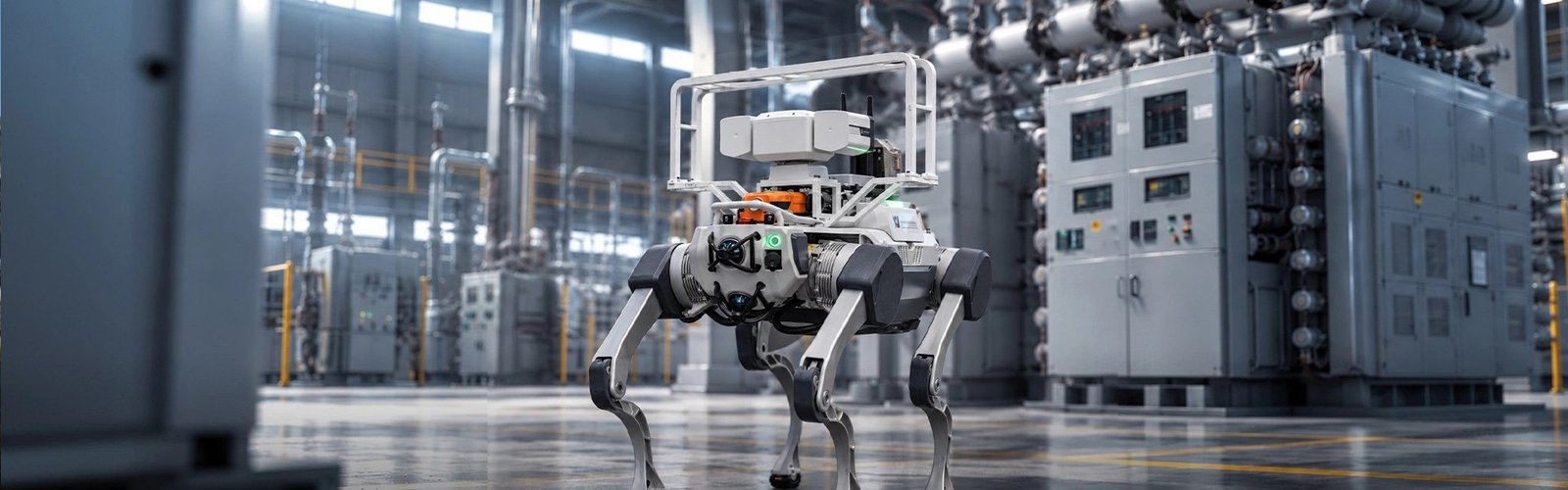
This is the terrain argument for legged and wheeled-legged platforms in civic roles. Wheels strand at the kerb the route forgot to mention; legs step over it and continue the round. Booster's public-services deployments are built on the quadruped and Lynx wheeled-legged lines for exactly this reason - the round must be completable on the site as it is, not as the brochure photographed it.
Role One: Delivery That Fits the Campus Scale
Campus and park delivery is a modest, genuinely useful job: documents, tools, samples and supplies moved between buildings on a schedule, releasing staff from courier duty measured in hours per week. The robot's value is not speed - it walks - but reliability and presence: the round happens, at the same times, in the same way, logged. Loads are light, recipients are known, and the route network is bounded, which makes delivery the gentlest entry role for public-space operation and an excellent acceptance-builder: the community meets the robot carrying something useful before it meets it carrying authority.
Deployment design matters more than platform choice here: handover points that do not block paths, schedules that avoid peak pedestrian flows, and a failure behaviour - wait safely, signal clearly, summon help - that bystanders read as competent rather than broken. Booster's industrial inspection and public safety solution treats public-service delivery as one role in a family, sharing routes and infrastructure with the patrol work below.
Role Two: Patrol and Environmental Rounds
Patrol in public space is mostly presence and observation: scheduled rounds that check gates, lighting, facilities and occupancy, recording what they find and escalating what departs from normal. Environmental rounds extend the same pattern to the site's condition - litter hotspots, damaged fixtures, flooded paths, fallen branches after weather - reported with position and imagery into the maintenance workflow. The output of both is not security theatre; it is a dated, located condition record of the whole site, produced nightly, that facility managers otherwise simply do not have.
These are the rounds Booster quadrupeds already perform in campus service - a flagship quadruped equipped with an embodied navigation system works campus patrol at a partner university in Xi'an - and the pattern scales across parks, exhibition grounds and civic campuses whose geography is too large for fixed cameras and too quiet at night for staffed rounds.
Acceptance: The Deployment Is a Relationship
Public robots are adopted or rejected socially before they are evaluated technically. The programmes that endure share habits: the community is told what the robot does and does not do, in plain language, before it arrives; its early duties are visibly useful; its behaviour around people is conservative to the point of comedy - it yields, it waits, it never insists on right of way; and there is a named human owner the public can address. Programmes that skip this work meet the predictable alternative: suspicion, interference, and a pilot quietly not renewed.
Acceptance also has a data dimension. Patrol and environmental robots observe public space, so the operator's policy on imagery - what is stored, for how long, who reviews alerts - should be published with the same prominence as the launch announcement. Booster's deployment guidance builds this policy conversation into project setup; it is cheaper to have it before the first round than after the first complaint.
Starting a Public Service Programme
Begin with one role, one bounded site and one named owner. Delivery on a campus route or patrol on a defined perimeter, run for a season, produces the evidence - completion rates, incident patterns, community response - that justifies extension to the other roles on shared infrastructure. The platforms and route software are the same; what grows is the institution's confidence, which is the actual asset being built.