
Who Uses It, Day to Day
On a working weekday the platform serves three groups at once: students running coursework experiments against deadlines, research teams iterating behaviours for publication and competition, and the laboratory's own engineers verifying customer-facing policies before release. That shared use is intentional - the same environment carries a first-year student's first trained gait and a research group's competition policy, which is how a laboratory builds a common technical culture instead of a shelf of incompatible tools, each understood by exactly one person.
A humanoid that learns on hardware learns slowly and breaks expensively. The robot simulation development platform is the other half of Booster's development offering: a virtual-physical simulation environment where behaviours are trained at scale, paired with a physical training ground where those behaviours are verified on real machines before anyone trusts them. This article explains what the platform contains and how the two layers work together.
What the Platform Does
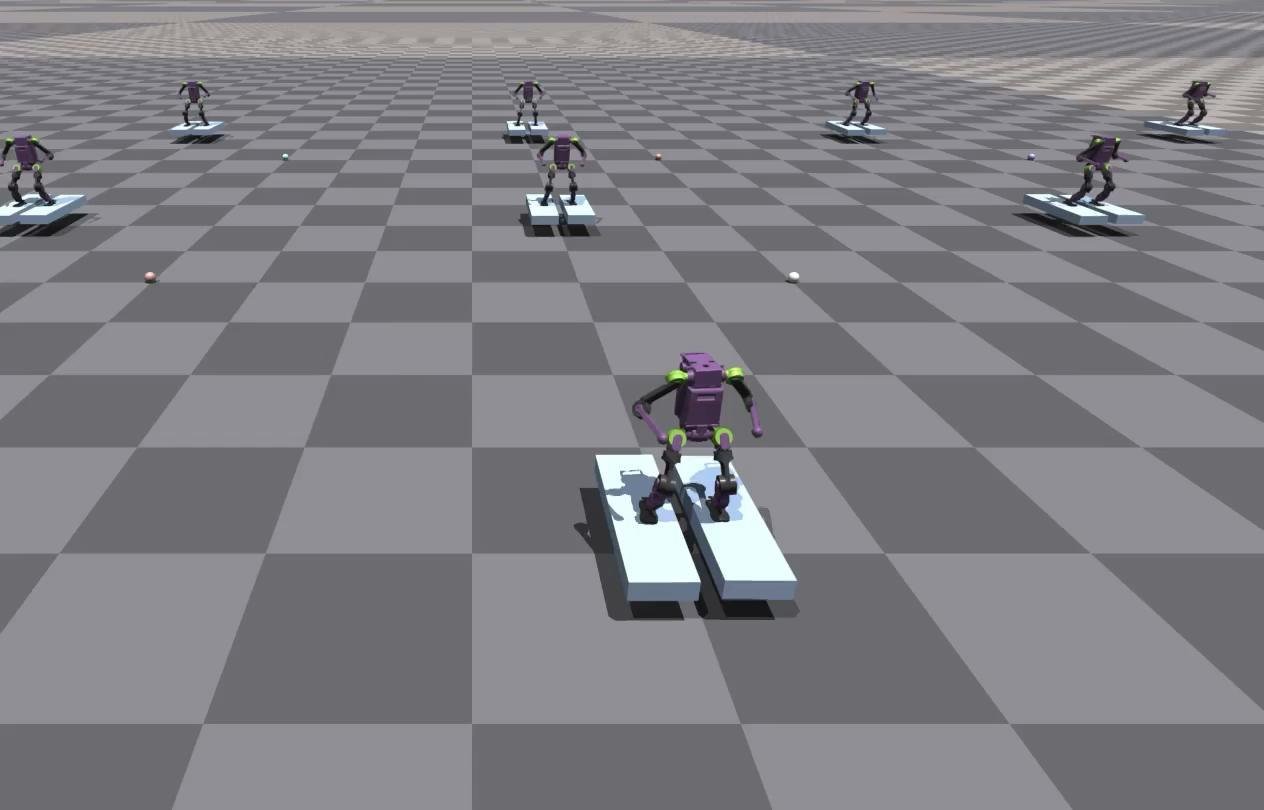
The simulation development platform provides the virtual side of the loop: simulated robots and environments in which locomotion, recovery and application behaviours are trained through the reinforcement learning framework, iterated thousands of times faster than hardware allows, and tested against conditions - surfaces, disturbances, scenario variations - that would take months to arrange physically. Policy training, deployment preparation and verification planning all live here. It is the environment in which Booster's own competition-proven behaviours are developed, and the same environment supplied to customer development teams.
The Training Ground Completes the Loop
Simulation has a known failure mode: policies that are brilliant in the virtual world and helpless in this one. The training ground is the corrective - a physical practice facility where trained policies meet real floors, real lighting, real sensor noise and real gravity, on the actual humanoid, quadruped and wheeled-legged platforms they will run on. The ground is laid out for application scenarios as well as locomotion: robot football pitches, patrol and inspection routes, handling setups. Verification there is a formal step, not a demo - a policy that has not passed the ground does not ship to a deployment.
Why the Pairing Matters for Universities
The platform-plus-ground combination is why our simulation and development laboratory is structured the way it is. Students need the loop, not just the software: the experience of training a behaviour, watching it fail physically, diagnosing the sim-to-real gap and closing it is the core skill of modern robotics engineering. A laboratory with only robots teaches operation; a laboratory with the full loop teaches development. Institutions evaluating platforms should therefore ask any supplier the same question - where, physically, do your policies get verified? - and weigh the answer heavily.
One Environment Across the Fleet
The platform serves the whole Booster range: humanoids for locomotion and football behaviours, quadrupeds for patrol and inspection scenarios, wheeled-legged platforms for hybrid-mobility work, and the developer tools connect the same workflow to each. For a laboratory or development team, that commonality is operational gold - one environment to learn, one verification discipline, applied across every platform in the building. It is also how Booster's internal teams work, which is why customer feedback on the tools reaches the people who use them daily.
Scope and Deployment
The platform is delivered as part of laboratory builds and developer programmes, with scope - robot models covered, training-ground configuration, curriculum integration - defined per project; the product page records the current deployment scope as it is confirmed for each configuration. What this article can state unconditionally is the principle: no Booster behaviour reaches a customer robot on simulation results alone. The loop - train virtually, verify physically, then deploy - is the product's reason to exist, and it is the standard we invite buyers to hold every simulation claim to, ours included.
Building a development laboratory or a team that trains its own robot behaviours? Compare the relevant product range and deployment scenarios to take the next step.