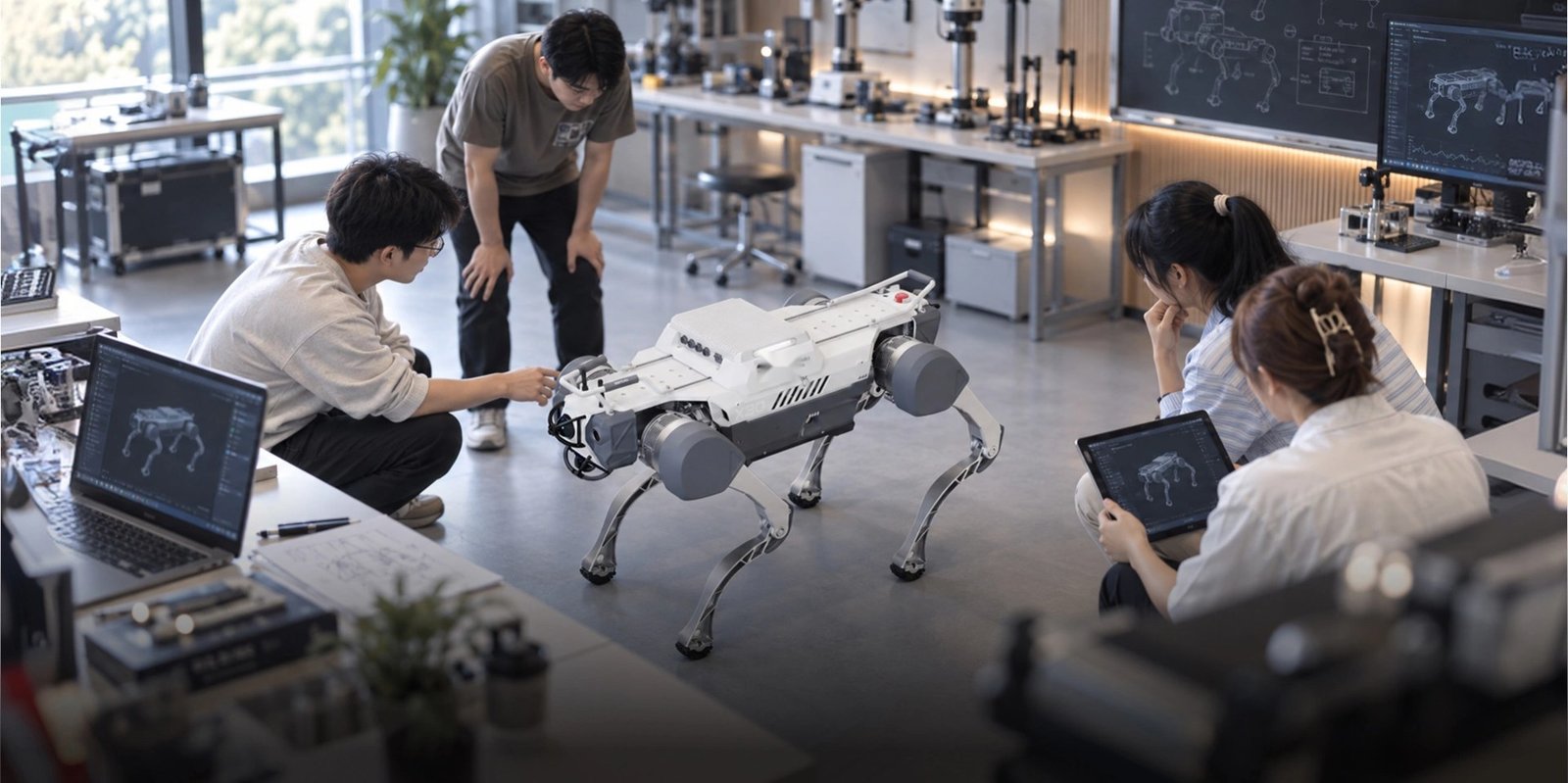

Visit enough university robot laboratories and a pattern emerges: the thriving ones are organised, the struggling ones are furnished. The difference is a model of what a laboratory is for. Booster's humanoid robot laboratory solution builds on three types - structure and principles, simulation and development, industry-specialised - each a distinct learning environment with its own equipment logic. This article explains the three types and how they interlock, expanding the overview in our guide to university laboratory building.
Type One: Structure and Principles - Know the Machine
The first laboratory teaches the robot itself. Students handle quadruped and humanoid platforms as engineered objects: body structures, joint arrangements and degrees of freedom, sensor fits, actuation, assembly and inspection routines. The structure and principles lab is deliberately tactile - components on benches, supervised disassembly and reassembly, measurement exercises - because every later sophistication depends on graduates who understand what the machine physically is. Safety and handling discipline are installed here, at the foundation, where they become professional habit rather than examination topic.
Type Two: Simulation and Development - Build the Behaviour
The second laboratory is where behaviours are created. On the simulation and development lab's workstations, students develop policies and behaviours in the virtual-physical simulation environment: train, test, break and refine in simulation, then deploy to the hardware standing by and verify against reality. This type carries the programme's software identity - the developer tools, the RL framework, the sim-to-real loop - and its throughput: because simulation parallelises, a whole cohort develops at once, reserving scarce robot hours for verification. Most student hours, in a healthy programme, are spent in this room. It is also where interdisciplinary teaching happens naturally, since behaviour design pulls in mathematics, computing and control at once.
Type Three: Industry-Specialised - Do the Job
The third laboratory imports the workplace. The industry-specialised lab is configured around a sector's scenarios - power inspection, emergency reconnaissance, patrol, handling - with the layouts, payloads and documentation standards of the real posts. Students run complete task chains to workplace criteria: plan the round, configure the platform, execute, log, hand over. This type is also the institution's interface with industry: employer projects, applied research and certification assessments live here, where the conditions are honest enough for the results to count.
Progression and Phasing
Students flow through the types in order - machine, behaviour, job - and the flow is the curriculum's skeleton. Institutions, equally, can phase the build in the same order: establish the structure lab with the first platforms, add the simulation capacity as cohorts grow, and fit the specialised lab once employer partnerships define its sector. Phasing keeps each investment teaching from its first semester, instead of a single grand opening followed by underuse. Each phase should open with its teaching purpose already timetabled, so new rooms start earning their place immediately. The mistake to avoid is buying type-three scenery for a programme that has not built types one and two; scenarios without foundations become theatre.
Sizing the Three Types to Your Institution
The ratios follow your programmes. Research-led universities weight the simulation type heavily; vocational colleges weight the specialised type; schools adapt the model at smaller scale with the structure and simulation functions combined. In every case the discipline is the same: name each room's purpose, equip to the purpose, and assess students in the room whose purpose they are demonstrating. That is what turns a purchase of robots into a laboratory system.
Planning a laboratory build or upgrade? Compare the relevant product range and deployment scenarios to take the next step.