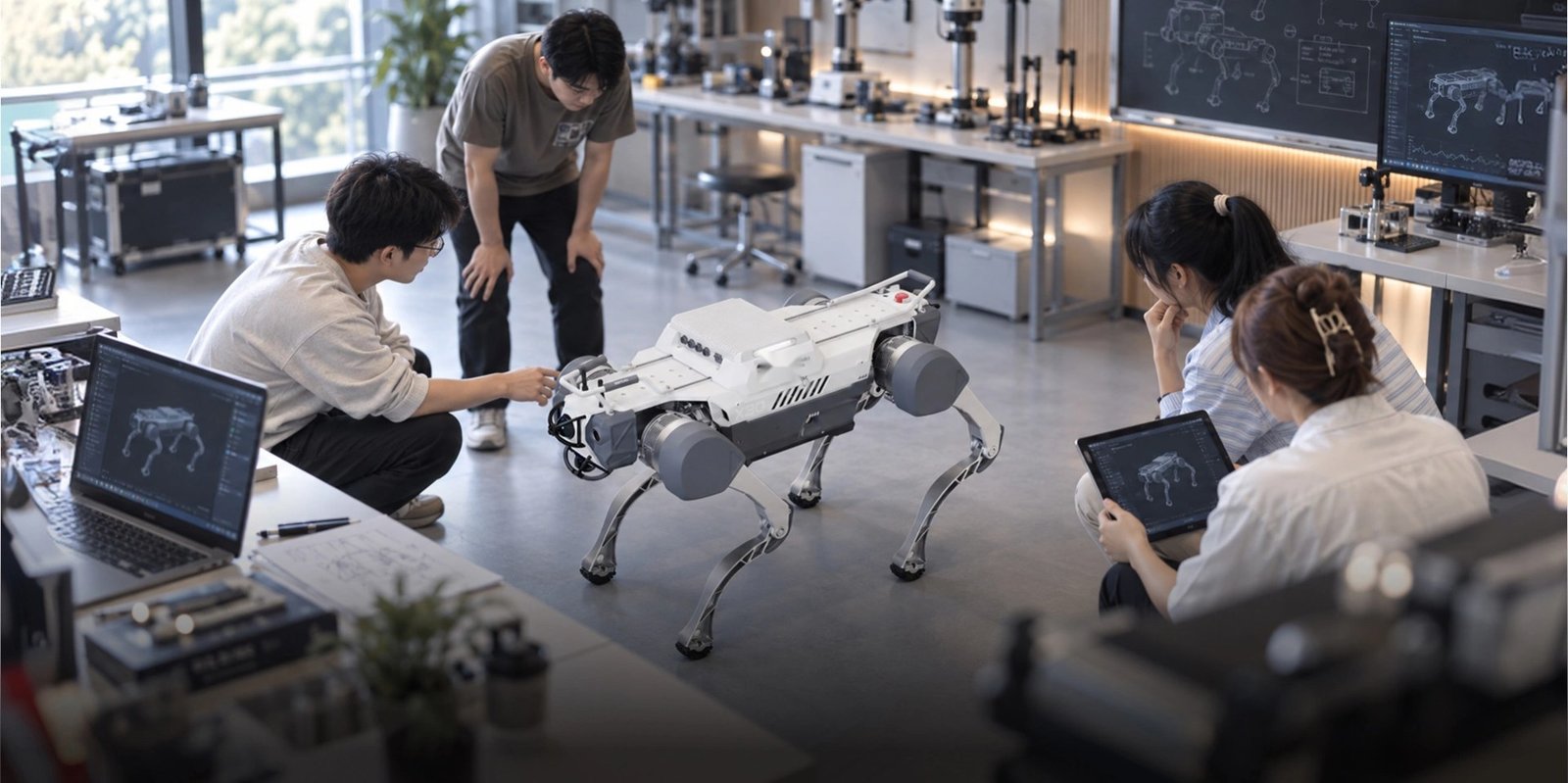

A research robot's invoice buys a machine at a moment in time. The institution then spends three years buying everything that makes the machine useful: staff hours to learn it, teaching material to run on it, spare parts when students meet physics, software environments to develop in, and service when something exceeds local repair. These are not hidden costs in any dishonest sense - they are simply absent from the headline figure committees compare. Total cost of ownership (TCO) is the discipline of pricing the whole commitment before choosing, so the comparison is between programmes rather than between chassis.
The Invoice Is the Down Payment
The structure generalises across platforms. Whether the laboratory runs humanoids, quadrupeds or both, the cost families repeat: acquisition, enablement (training and curriculum), operation (service, spares, consumables, energy), software, and the opportunity cost of downtime and underuse. Only the first family appears in the humanoid robot price.
Enablement: The Cost Line That Decides Everything
Enablement is where TCO is won or lost, because it converts directly into utilisation. Teacher training until staff run sessions unaided, curriculum mapped to real courses, developer-tool onboarding for research students: each is a modest line item, and together they decide whether the fleet teaches two hundred student-hours a week or decorates a showcase cabinet. Institutions should ask suppliers to quote enablement explicitly and to evidence it - training curricula, course materials, certification structures - rather than accepting 'training included' as a phrase.
Booster's laboratory programmes bundle these layers deliberately - curriculum development, teacher training, competition practice and student certification alongside the robots - because our own delivery experience says utilisation is built, not hoped for. When a competing bid is cheaper, the first TCO question is which enablement lines it quietly excludes.
Operation: Spares, Batteries and the Price of a Cancelled Session
Operating costs are dominated by incidents and time. A joint damaged in week two costs the part, the freight, and - if no spare sits on the shelf - the sessions cancelled while it travels. Battery packs age on a cycle count whether the robot works or waits. Preventive maintenance consumes technician hours that must exist in someone's job plan. None of these lines is large; together they routinely reach a significant fraction of the purchase price across three years, and they vary enormously between suppliers: parts pricing, local stock, remote-diagnostics capability and documentation quality are TCO variables disguised as service details.
Downtime deserves its own line because it compounds: a robot awaiting repair during the only month a course runs has not cost a repair - it has cost the course. Committees should ask for spare-part lead times in writing and price a starter spares kit into the acquisition. The discipline is identical to the one Booster applies in its own humanoid robot range support model: the cheapest incident is the one the shelf already contains.
Software and the Upgrade Path
Research robots live or die by their software trajectory. Developer tools, simulation environments and policy frameworks that are actively maintained multiply the platform's useful life; frozen software strands the hardware at the state of its purchase year. TCO should therefore include any licence or subscription lines honestly, and weigh the supplier's release cadence as an asset: a platform whose walking, recovery and tooling improve by update is appreciating in a way a static one cannot. Booster ships its developer tools and RL framework with the platform and develops them in the open rhythm of its competition programme - the same updates our own teams run.
There is a matching staff-time item: every hour a researcher spends fighting an undocumented API is an hour bought at researcher rates. Documentation quality is a cost line. Evaluate it during procurement by having a student - not the professor - complete a timed task in the supplier's environment.
The Utilisation Denominator
TCO is finally a ratio: total cost divided by productive hours. A mid-priced platform in daily teaching and research use delivers robot-hours at a fraction of the unit cost of a bargain platform used monthly. This is why the model punishes false economy so reliably - savings at acquisition are fixed and small, while utilisation losses recur weekly for years. The committee's most valuable TCO activity is therefore not negotiating the chassis price but engineering the programme: courses scheduled, competitions entered, research groups onboarded, public demonstrations booked.
Build the model before you buy: three years, all five cost families, honest utilisation scenarios (planned, pessimistic, optimistic). Then let suppliers bid against the model rather than against each other. Compare the relevant product range and deployment scenarios to take the next step.