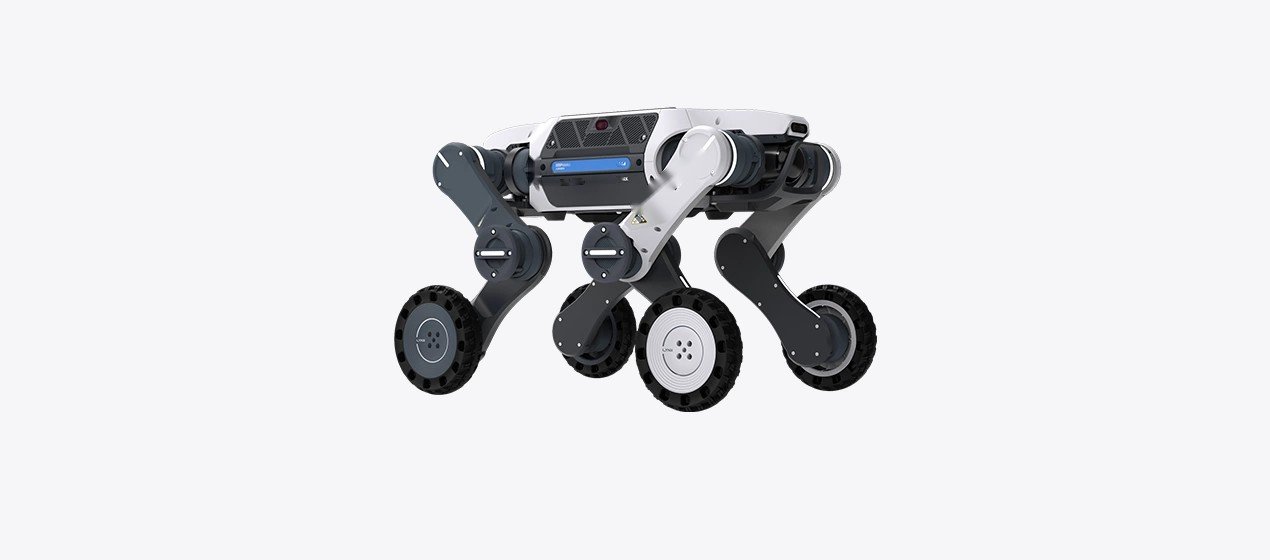

Some robot categories are defined by their shape; the wheeled-legged robot is defined by a refusal - the refusal to accept that a machine must choose between rolling and stepping. Its wheels sit at the ends of articulated legs, and it uses each mode where that mode is best. This article explains the category plainly: how hybrid mobility works, what it costs, and why the mixed terrain of real facilities has made it one of the most practical ideas in mobile robotics.
The Anatomy: Wheels Where Feet Would Be
Take a quadruped's leg - articulated, actuated, able to lift, place and stabilise - and finish it with a driven wheel instead of a foot. The result can roll: driving the wheels moves the machine with wheeled efficiency while the legs hold posture. It can also step: lifting a wheel over an obstacle, climbing a kerb or a stair, bracing on broken ground. The legs double as an active suspension, keeping the body - and any payload - level across ground that would shake a rigid chassis. One platform, two locomotion modes, and a body that behaves like neither parent category alone.
Mode Switching Is the Intelligence
The hardware is only half the idea; the category lives or dies on when it switches. Rolling on flat ground, stepping at an obstacle, blending the two on rough patches - the transitions must be automatic, timely and stable, decided from the robot's perception of the terrain ahead. This is an embodied navigation problem as much as a mechanical one, and it is why wheeled-legged platforms have matured alongside modern perception and learned control: the legs always could step, but knowing when, without a human teleoperator making the call, is the recent achievement that makes the category deployable.
Why It Matters: The Mixed-Terrain Majority
Most working environments are mixed. An industrial site is yard, ramp, plant floor and threshold in one route. Infrastructure inspection is service road and rough access in one round. A campus is pavement, kerb and lawn edge in one patrol. Pure wheels fail such routes at their broken fraction; pure quadrupeds complete them but pay legged energy costs across every prepared metre. Hybrid mobility prices the route as it actually is. Booster's Lynx series - the compact S10 and the heavier-payload M20S - is built on exactly this reading of real routes.
The Honest Costs
Hybrid is not free lunch. A wheeled-legged robot is mechanically and computationally more complex than either parent: wheels add drive systems to legs that already have joints, and the control stack must master two locomotion regimes and their transitions. On a route that is purely flat, a plain wheeled robot remains cheaper and simpler; on a route that is purely rough, a pure quadruped's stepping is uncompromised. The wheeled-legged case is the middle - and the discipline is measuring your route's mixture before romanticising the hybrid, a method our comparison of quadruped and wheeled mobility sets out in full.
Where the Category Is Heading
As perception and control improve, the mode-switching gets smoother and the middle ground widens: routes that once forced facility adaptation or human rounds become single-platform work. Expect wheeled-legged machines to become the default evaluation starting point for inspection, patrol and field logistics wherever the terrain refuses to be one thing. For buyers, the practical takeaway is present-tense: if your route is mixed, put a hybrid on the evaluation list beside the pure options, and let the route - walked, measured, scored - make the decision.
Working a route that is part road, part obstacle course? Compare the relevant product range and deployment scenarios to take the next step.