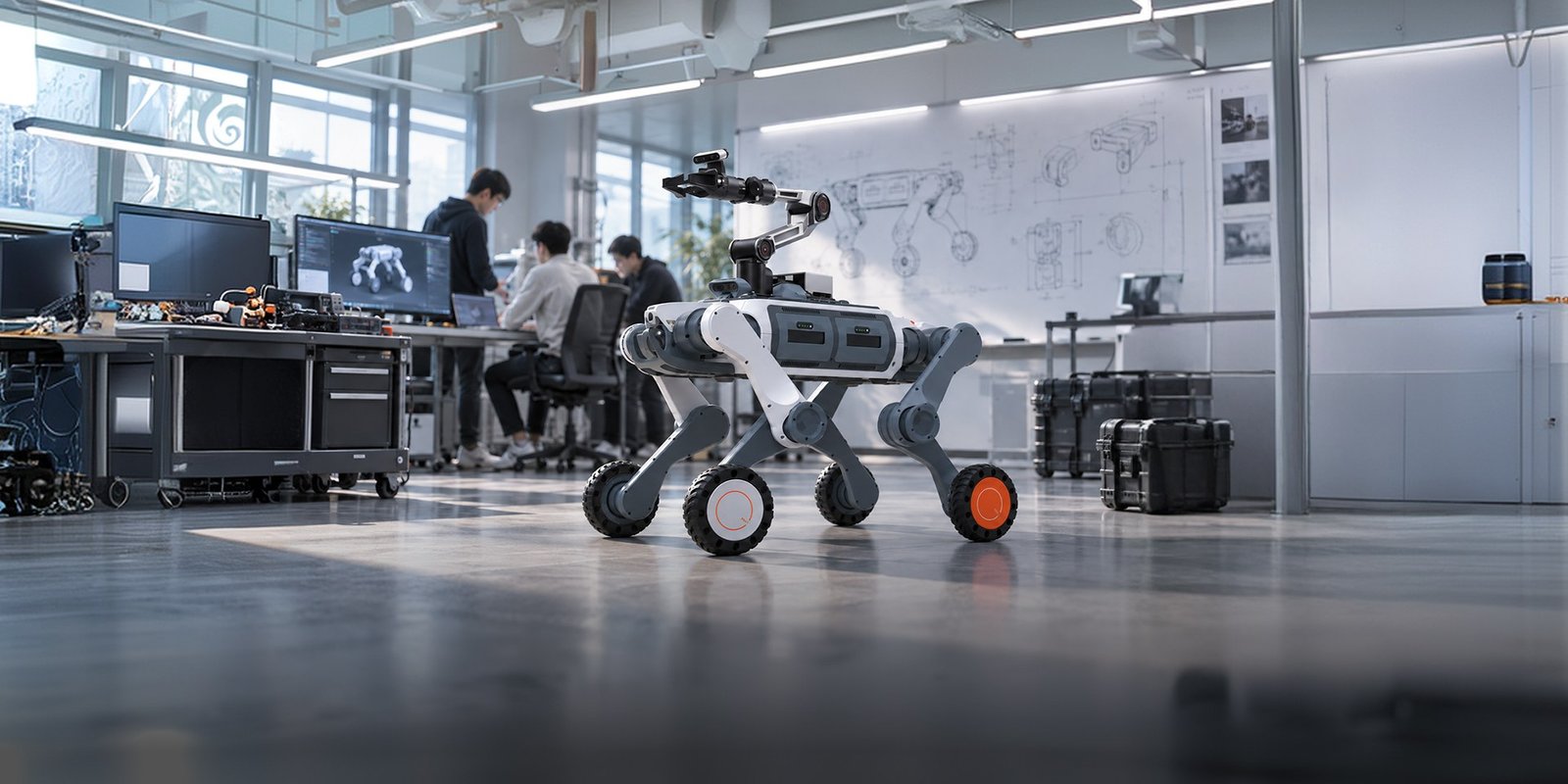

Airport automation has a remainder problem. Fixed systems handle standard suitcases beautifully, then meet a soft backpack with loose straps, an overstuffed handbag, a oddly balanced duffel - and stop. The wheeled dual-arm humanoid robot exists for that remainder: a mobile platform with two articulated arms, built to perceive an irregular object, decide how to hold it, and move it safely. This article introduces the machine in detail, and its place in the baggage handling model Booster delivers.
The Specification, Plainly
The platform stands 1,390 mm tall on a 465 x 545 mm footprint and weighs under 95 kg - dimensions that let it work in the service spaces of a baggage hall rather than demanding its own hall. Each arm offers 7 degrees of freedom excluding the end effector, with a 620 mm reach; payload is 6 kg on a single arm and 12 kg across both, which covers the realistic weight range of the irregular bags it is built for. Navigation combines dual LiDAR with depth-vision SLAM, and the battery is rated for 8 hours of operation. The full table is on the product page.
Two Arms, Because Bags Are Not Boxes
Seven degrees of freedom per arm is a design statement. Handling an irregular bag is a two-handed problem: one hand stabilises while the other secures, a soft body deforms as it is lifted, straps and handles present themselves at unpredictable angles. Dual arms let the robot cradle, re-grip and set down objects whose centre of mass moves as they are carried - the exact behaviours that make the flexible stream flexible. This is dexterous manipulation applied to a working problem, guided by the VTFLA embodied AI architecture described on our technology pages: vision, touch, force, language and action in one model.
Its Place in the 80 / 10 / 10 Model
Booster's baggage model divides the stream by difficulty: about 80 percent standard bags flow through the DawnAnt transfer robots, about 10 percent - the irregular stream - belongs to this humanoid, and about 10 percent stays with people for the truly exceptional. The division is the product. A buyer does not have to choose between rigid automation that rejects a tenth of the flow and a humanoid asked to do everything; the fleet is composed so each stream meets the machine shaped for it, coordinated by the scheduling platform in the wider smart airport solution.
Navigation in a Working Hall
A baggage hall is a moving environment: trolleys, staff, other robots, bags that were not in the plan. Dual LiDAR plus depth-vision SLAM gives the platform redundant spatial awareness - laser geometry for structure, depth vision for the objects and people within it - so it can work its routes through a live hall rather than a cleared one. The wheeled base is the honest choice for this terrain: terminal floors are flat, routes are long, and rolling efficiency across an 8-hour shift matters more than step-climbing the platform will never be asked to do.
Where Else This Platform Earns Its Keep
Although it was specified for irregular baggage, the platform class - mobile base, dual dexterous arms, rich perception - is the flexible-handling pattern other logistics and service environments ask about: mixed-object handling, flexible picking support, environments where the objects refuse to be standardised. Evaluations start from the object set: shapes, weights, surfaces, and the rate the stream arrives at. Our team scopes those variables with buyers before proposing the platform, because flexible handling succeeds or fails on the match between the machine's envelope and the real objects.
Got an irregular stream that fixed automation keeps refusing? Compare the relevant product range and deployment scenarios to take the next step.