
Stand on one foot and reach for a high shelf: your ankle, knee, hip, spine and opposite arm all move, none of them by independent decision. Humanoid balance works the same way because the physics is the same - the body's mass distribution over a small, changing support area must be managed continuously, and every joint either contributes to that management or sabotages it. Controllers that treat legs as a walking module and arms as a separate manipulator discover the conflict the first time the robot reaches sideways while stepping: the reach moves the mass, the step was planned for a different mass position, and the floor settles the argument.
Balance Is Not a Leg Feature
Whole-body motion control removes the seam. One controller owns all joints and all objectives simultaneously - balance first, then the task, then economy of motion - resolving conflicts by priority rather than by accident. It is the architectural decision underneath every capability a humanoid advertises, from stair climbing to carrying a tray.
Priorities: What the Controller Sacrifices First
A whole-body controller is best understood as a hierarchy of promises. The top promise is never negotiable: keep the centre of mass and angular momentum within what the current contacts can support - do not fall. Below it sit the task promises: the foot lands where the gait requires, the hand reaches the target, the gaze or tool stays oriented. Below those, preferences: use less torque, keep joints near comfortable middles, move smoothly. When the world interferes - a push, a slip, a heavier load than expected - the controller degrades gracefully down the hierarchy, sacrificing smoothness, then task precision, and defending balance to the last.
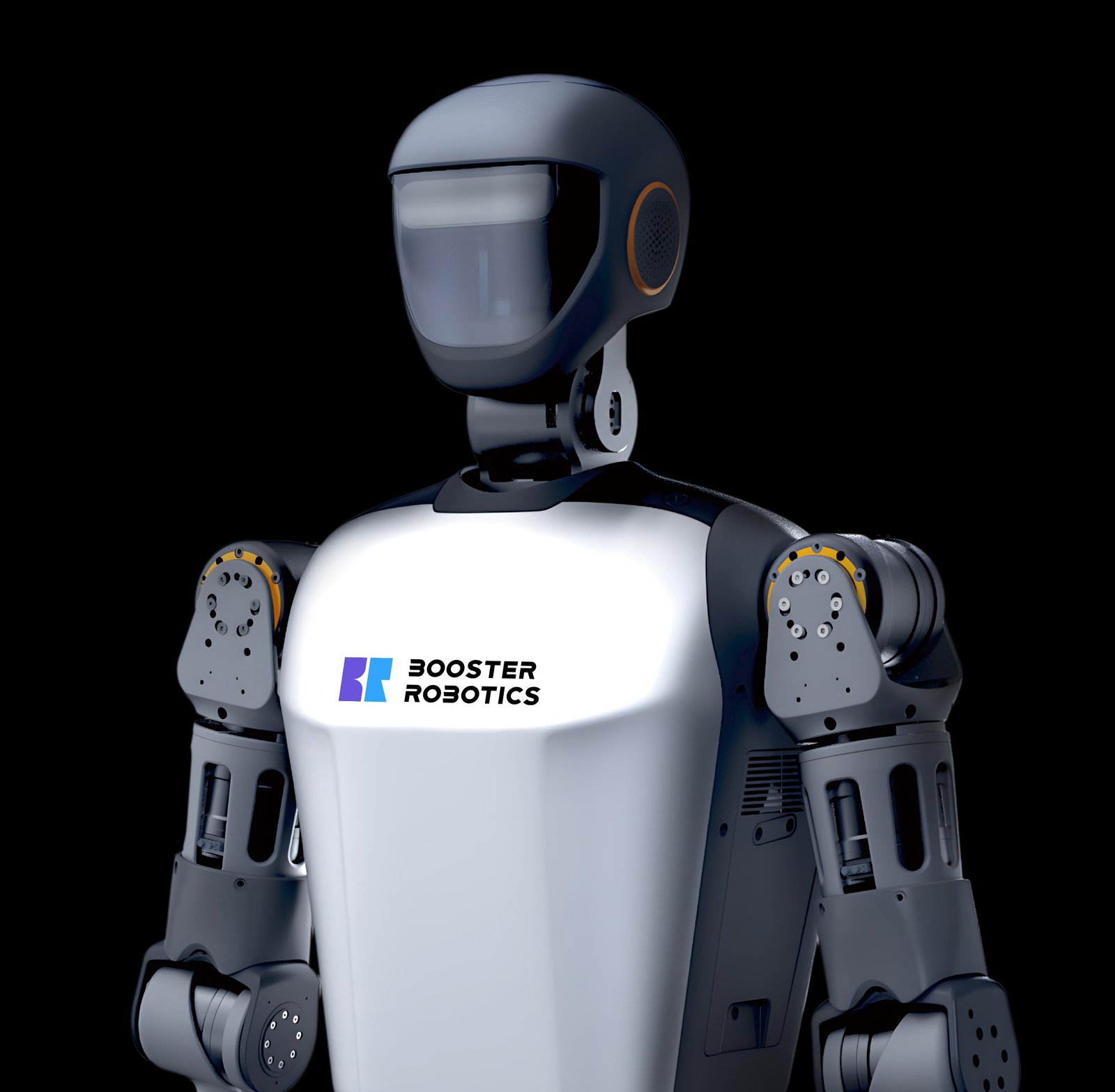
This is why two humanoids with identical joint counts perform so differently in the field. The hardware sets the envelope; the controller's priorities decide what happens at the envelope's edge. Booster's control stack descends directly from its founding team's two decades of robot football research, where the edge of the envelope is visited every match, in public, with consequences. The Booster T1 runs the current generation of that stack on its 23 degrees of freedom.
Learning Meets Control: Policies Inside the Hierarchy
Modern whole-body behaviour is increasingly learned rather than hand-derived: reinforcement learning policies, trained in simulation across millions of falls, perturbations and terrain variations, discover coordination strategies no engineer would write by hand. But learning does not abolish the hierarchy - the policy operates inside it, proposing motions that the balance layer validates, and the training process itself encodes the priorities: falls are the most expensive outcome in the reward, so recovered balance is what the policy learns to value above style.
Booster's pipeline trains these policies through its developer tools and RL framework and verifies them through sim-to-real transfer before they run on hardware. For research customers this matters practically: the whole-body layer is not a black box bolted under their work - it is the documented foundation their own policies build on, with the same training loop the factory uses.
What Whole-Body Control Unlocks
With the hierarchy in place, capabilities compose instead of conflicting. The robot can walk while carrying - the arms' load is part of the balance calculation, not an afterthought. It can brace, lean and use contact beyond its feet. It can manipulate from a stance chosen for the task rather than frozen in a standard pose, and it can absorb the reaction forces of its own actions - the push-back of a heavy door, the tug of a snagged bag - as disturbances to reject rather than emergencies. Each of these reads as a separate feature in a brochure; underneath, they are one feature.
The competition field remains the honest audit. A football humanoid is pushed, tripped and crowded while sprinting, turning and kicking - whole-body control under adversarial conditions, scored publicly. Booster's 2025 RoboCup world title, the first for a Chinese team in 28 years, was won on exactly this stack, which is why the same platform anchors our robotics competitions solution for university teams.
Evaluating Control Quality as a Buyer
Brochures cannot express control quality, but demonstrations can. Ask for the unglamorous tests: walk and turn in place on the spot; a side reach at full extension while standing; a gentle push from an unexpected direction; a carried load shifted mid-walk. Watch the recovery style - small, early corrections indicate a controller with margin; large, late ones indicate a machine at its limit pretending otherwise. Whole-body control is the humanoid's core competence, and it is visible to any observer who knows to look at the disturbances rather than the routine.