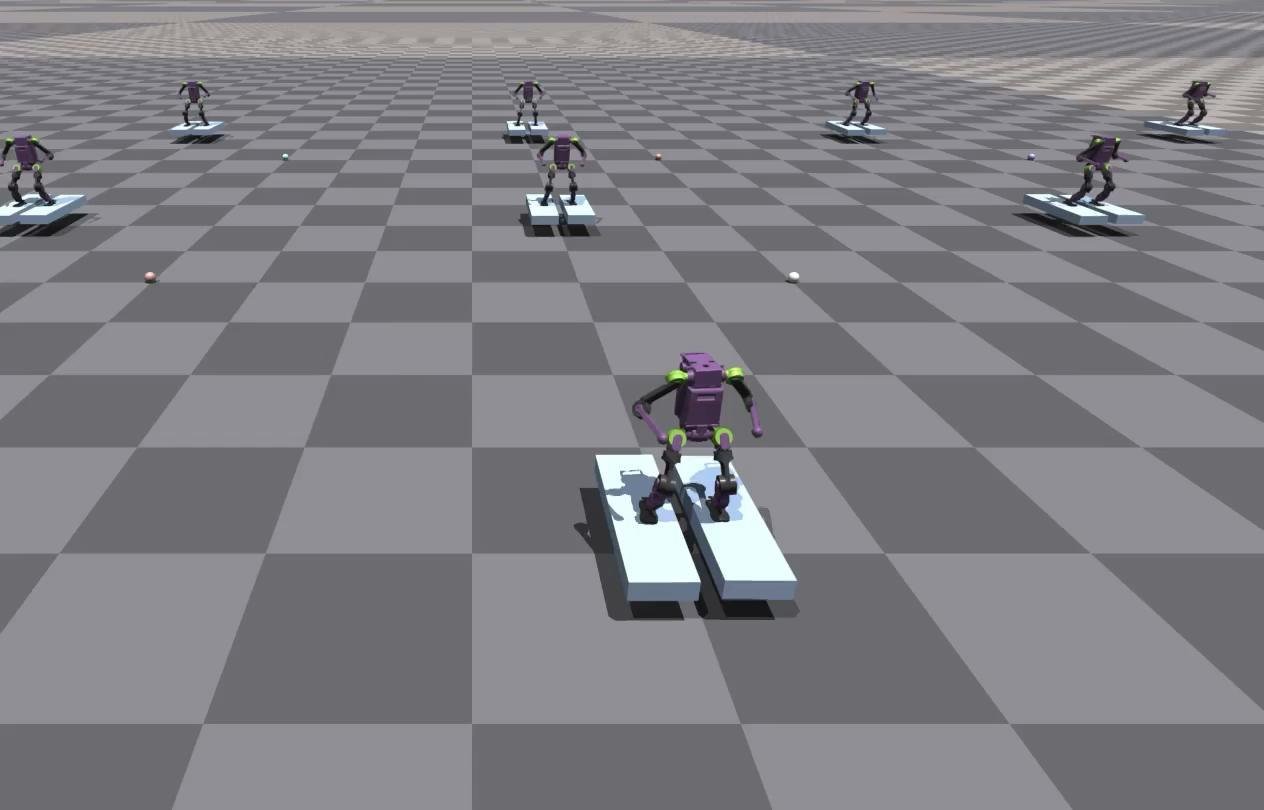

Every sim-to-real programme has a moment of truth: the policy leaves the simulator and meets a floor. A robot training ground is the designed space for that meeting - part proving ground, part laboratory instrument - where locomotion, manipulation and team behaviours are exercised against real physics before they are trusted anywhere else. Booster operates such grounds for its own development and builds them into customer laboratories; this article sets out the design decisions that separate a training ground from an empty hall with robots in it.
Space and Surfaces: Variety Is the Specification
A training ground earns its keep through controlled variety. The floor plan zones distinct surface types - smooth laboratory flooring, matting, ramps, steps and thresholds, a marked pitch area for football work - because a policy verified on one surface has been verified on one surface. Ceiling height and clear volume matter for humanoids that fall, are caught, and are worked on at benches around the perimeter. Size follows the fleet: enough room for the largest behaviour in the programme - a patrol route segment, a football scrimmage, a handling cell - plus the safety margin around it, rather than a grand arena that sits mostly empty.
Zoning and Safety for People in the Loop
Training grounds are workplaces where people and moving robots share space deliberately, so the safety design is explicit: marked operating zones with entry discipline, unambiguous stop controls at the zone edge and with the operator, sightlines that let a supervisor see every active robot, and a session protocol - who is running, what behaviour, what the abort criteria are - logged before machines move. In our simulation and development laboratory builds, the ground's zoning mirrors the simulator's scenario boundaries, so a behaviour graduates from the virtual zone to its physical twin under the same rules.
The Scenario Library: Obstacles With a Purpose
Between the bare floor and the real world sits the obstacle library: steps and ramps of graded heights, doors and thresholds, barriers and gates, handling props from cones to carts to bags of varied awkwardness. Each item exists to exercise a named capability, and the library is catalogued like one - a scenario card states the setup, the behaviour under test and the pass criteria. This is what converts practice into training: repetitions against a defined standard, varied systematically, rather than robots wandering a cluttered room while everyone calls it robustness testing.
Measurement: A Ground That Reports
A training ground should produce evidence, not just experience. Fixed cameras covering the zones, a simple timing and logging habit for runs, and the platform's own telemetry together build the record each policy version is judged by: success rates per scenario, failure modes catalogued, regressions caught when a new version walks worse than the last. Booster's own simulation development platform workflow treats the ground as the verification stage of the pipeline - the place where simulation's claims are audited - and the audit trail is what lets a team trust a policy enough to deploy it in a customer's laboratory or a competition.
For Teams: The Ground as a Home Fixture
Competition and research teams feel the ground's value as rhythm: scheduled access, a maintained scenario library, equipment that is set up rather than searched for. Programmes that treat the training ground as shared infrastructure - booked, logged, reset by its users to a standard state - get multiples more value from the same square metres than those where the space is negotiated daily. Design the rota and the reset checklist with the same care as the floor plan; in practice, they are the same document.
Building a training ground into a laboratory or team facility? Compare the relevant product range and deployment scenarios to take the next step.