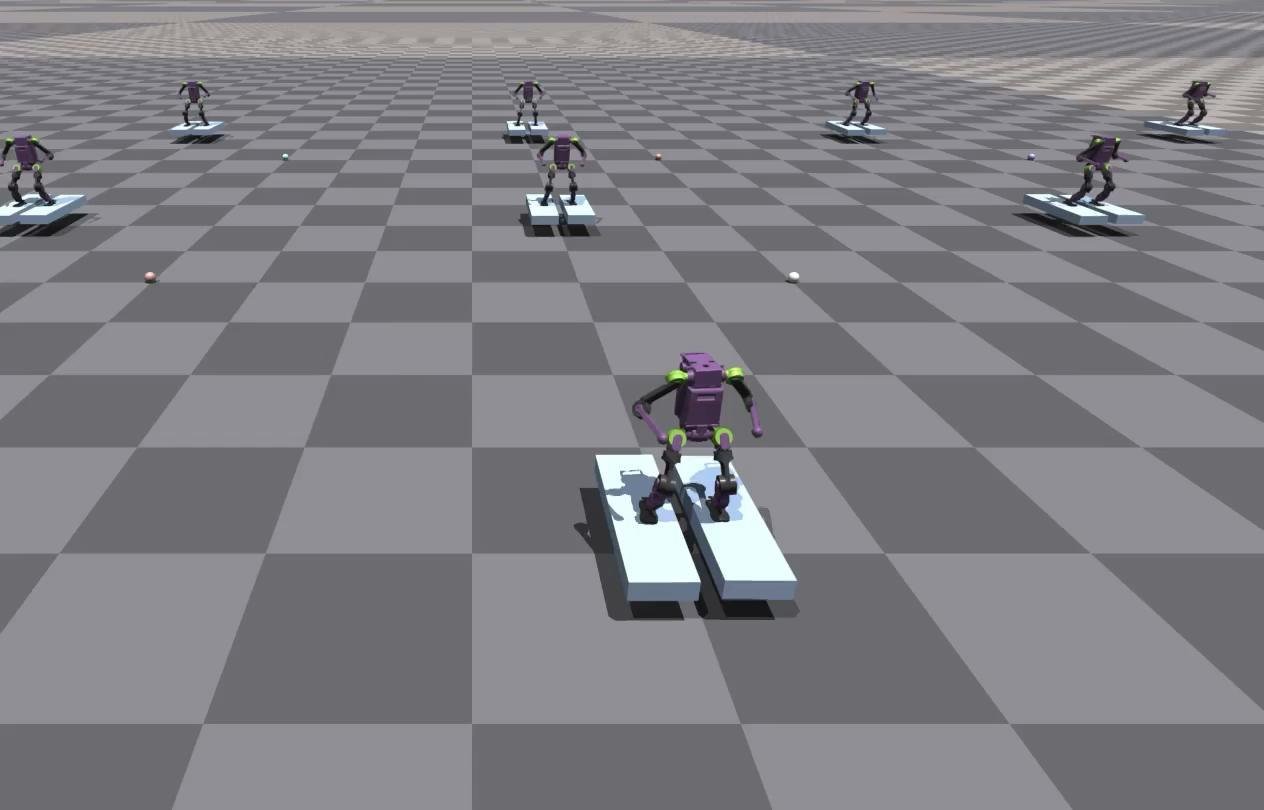

Ask a research team what decides a humanoid purchase three years later, and the answer is rarely the hardware - it is the software they were handed on day one. The humanoid robot developer tools and reinforcement learning framework supplied with the Booster T1 and K1 are built to be that deciding factor: a complete workflow from behaviour idea to running robot, shipping with the proven baselines a team should never have to rebuild. This article explains what the tools contain and how the workflow runs.
The Workflow, End to End
The developer tools support the full development loop. Behaviours are defined and trained in simulation through the RL framework; policies are verified - first in the virtual environment, then on hardware at the training ground - and deployed to the robot through the documented sim-to-real pipeline. Once running, the robot's real behaviour feeds back: logs and performance on the physical machine inform the next training round. Idea, training, verification, deployment, measurement, iteration - the loop is the product, and each stage is tooled rather than improvised.
Start From Working Baselines, Not an Empty Repository
The framework's most consequential feature is what it starts from. Booster platforms ship with the behaviour set our own teams compete with: walking, robot football skills and fall-and-get-up recovery, trained through this same framework and proven at the highest level - including the 2025 RoboCup world title won on this platform class. A customer team's first project is therefore an extension or a study, not a resurrection: modify a gait, adapt a recovery policy, build a new behaviour beside working ones. For teaching laboratories, the baselines double as curriculum artefacts - students can inspect what good looks like before they are asked to produce it.
One Toolchain Across T1 and K1
The tools serve both developer humanoids. A university can teach on the compact K1 and research on the flagship T1 without splitting its software skills across two ecosystems; a competition team can develop on one platform and field the other. That continuity is deliberate product design, and it extends to the wider fleet's simulation platform, so quadruped and wheeled-legged projects live in the same development culture. Licence and deployment scope for specific programmes are defined per project, and the product page records scope as confirmed.
Built by the Team That Uses It
Booster's developer tools are not a sideline product maintained by a separate software house; they are the working environment of the engineering team whose research roots run through the Tsinghua Vulcan programme and more than 20 years of humanoid development, with dozens of top-tier publications behind the methods inside them. Tooling built under competition deadlines has a particular quality: iteration speed is survival, and clumsy workflows get fixed or get their authors beaten. Customers inherit that pressure-tested workflow, and their feedback goes to engineers who will use the same tools on Monday morning.
Judging Developer Tools Before You Buy
Our standing advice to evaluation teams: make any supplier demonstrate the loop, not the interface. Ask to see a behaviour trained, verified and deployed; ask what baselines ship and who proved them; ask how a policy moves from simulation to the robot you are buying, and what happens when the first deployment misbehaves. A supplier confident in its tools will relish those questions. Booster's answers are on the product page and in our primer on reinforcement learning for humanoids later in this series - and the engineers will walk the loop live for any serious evaluation.
Evaluating developer platforms for a research group or teaching laboratory? Compare the relevant product range and deployment scenarios to take the next step.