Booster Robotics on CCTV-5: T1 at the 2025 World Humanoid Robot Games
CCTV-5 broadcast the 2025 World Humanoid Robot Games, with a Booster T1 on stage at the National Speed Skating Oval. Booster Robotics supplied the platform behind the football teams and supported more than 40 squads.
DawnAnt Baggage Transfer Robot: 180 Pieces per Hour, Around the Clock
Booster Robotics introduces the DawnAnt baggage transfer robot for airport terminals. A 6-DoF collaborative arm with a 2,000 mm reach and a suction-cup and gripper composite end effector identifies, grips and loads standard suitcases at up to 180 pieces per hour, running 7x24 through peaks and holiday surges. DawnAnt carries the standard flow in the 80 / 10 / 10 human-robot collaboration model, while a wheeled dual-arm humanoid handles irregular bags - with every bag recorded for full-process traceability.
What to Ask Robot Suppliers at an Exhibition - A Buyer Checklist
Exhibitions are the best place to compare robot suppliers - and the easiest place to be sold a demonstration instead of a product. This buyer checklist, assembled from the questions Booster Robotics' own engineers would ask, covers what to verify before you buy a humanoid robot: specifications you can check, live tests to request on the stand, the software and developer ecosystem questions that decide long-term value, and the service, spare-parts and certification paperwork to ask for in writing. Bring it to the next show.
Every exhibition stand learns the same lesson: crowds gather where something moves, competes and occasionally falls over. At Booster Robotics' recent exhibition appearances, the live robot soccer demonstrations on our RoboCup humanoid robot platform drew the deepest crowds of the hall - and, more importantly, started the most serious conversations, with universities, schools and distributors who stayed after the matches to talk laboratories, curricula and teams. This recap covers what was shown, the questions visitors asked most, and what happened after the final whistle.
Meet Booster Robotics at Robotics Exhibitions: Live Humanoid & Quadruped Demos
Booster Robotics demonstrates its robots live at robotics and education exhibitions: humanoid robots playing robot soccer, quadruped robots on patrol scenarios, and the DawnAnt baggage transfer system in action. Exhibition visitors can see the Booster T1 and K1 humanoid robots, the Jueying quadruped line and the baggage handling robots working - not just standing on a podium - and talk through laboratory, airport and inspection projects with the team. This page explains what we show, who should book a meeting, and how to arrange one.
Booster Open Day: Developers Visit the Robot Football Training Base
Booster Robotics opened its robot football training base to developers, educators and prospective team coaches for an open day built around a simple principle: no slides about the robots when the robots are in the room. Visitors watched robot soccer robots train and scrimmage, saw fall-and-get-up skills demonstrated on demand, walked through the sim-to-real toolchain with the engineers who maintain it, and tried the developer workflow themselves. This article recaps what was shown - and how your institution can arrange the same visit.
How Booster Packs and Ships Robots to 20+ Countries
More than 200 customers in over 20 countries means Booster Robotics runs humanoid robot export as a routine operation: protective crating designed around each model's fragile points, battery transport handled under the UN38.3 regime the flagship T1 is certified for, model and market documentation packed with the machine, and staged shipments for laboratory projects. This article opens the crate - literally - and explains what happens between a confirmed order and a robot walking in a laboratory on another continent.
Booster Robotics Joins Industry Standards Discussions for Humanoid Robots
As humanoid robots move into schools, campuses, airports and factories, the rules they operate under stop being a legal footnote and become a purchasing criterion. Booster Robotics has joined industry standards discussions for humanoid robots, contributing field experience from more than 1,000 shipped robots to work on safety expectations, interoperability and testing practice. This article explains why standards are suddenly urgent, what the discussions actually cover, and the questions buyers should ask any supplier today - before the formal rules finish catching up.
This annual review looks back at the year embodied AI robots stopped being laboratory curiosities and started doing scheduled work: a RoboCup world title won on a production-class platform, more than 1,000 robots shipped and RMB 100 million in revenue, baggage transfer automation running in airport service, quadruped patrols on campus duty, and joint laboratories opening at partner universities. Booster Robotics' year, in one article - the milestones that mattered, the lessons they carried, and the work now in front of the industry.
Booster Robots Demonstrate Fall-and-Get-Up Skills in Live Test
Walking demos are easy to stage; getting up is not. In a live test session, Booster humanoid robots demonstrated their fall-and-get-up skills - falling, recovering to standing without assistance and resuming walking - using the same fall recovery policies trained through the company's reinforcement learning framework and sim-to-real pipeline. This article explains why recovery is the skill that separates working humanoids from demonstration humanoids, how the behaviour is trained and verified, and what evaluators should look for when they test any biped.
Team Growth: Booster Doubles Its Embodied AI Engineering Hiring
Booster Robotics is doubling its embodied AI engineering hiring, expanding the teams behind locomotion control, perception, simulation and platform software as orders, laboratory projects and industry deployments grow. For an embodied AI company whose founding team spent 20 years in a Tsinghua research group, hiring is a product decision: the engineers recruited now define how fast customer teams get better walking, better recovery and better tools. This article sets out where the new roles sit and what the growth means for customers.
Booster Robotics Service Network: Spare Parts and Support Explained
A research robot that waits a month for a part is a research programme on hold. This article explains how Booster Robotics' service network actually works: which spare parts are stocked and how they are identified by model and serial record, how remote diagnostics through the software platform resolve many issues without shipping anything, what documentation and training customers receive, and how distributor partners provide first-line humanoid robot support locally in the markets they serve. The goal is simple: a robot that is down should be a short interruption, never a cancelled semester or a missed competition.
Quality System Update: How Every Booster Robot Is Tested Before Shipping
Every Booster robot passes the same documented test gate before it is packed: joint-by-joint mechanical checks, walking and motion verification, sensor and compute validation, software and policy version recording, and a final packing inspection. This quality system update walks through each stage and explains why humanoid robot quality is decided by process rather than by final inspection luck - and what documentation travels with the robot so the customer's own acceptance testing starts from evidence, not hope. The update also covers the certification documentation that accompanies each model into its destination market.
How to Choose a Humanoid Robot for Research: 7 Criteria That Actually Matter
Choosing a humanoid robot for a research laboratory is not about the longest spec sheet. This article sets out seven criteria that decide whether a platform produces papers or gathers dust: degrees of freedom and expandability, on-board AI compute, endurance matched to your experiment cycle, the sensor suite, the maturity of the developer tools and reinforcement learning framework, sim-to-real support, and certifications for your market. It closes with a worked comparison of a flagship 1.2 m platform and a compact 0.95 m platform, and when each is the right buy.
Booster Robotics' quadruped robots have joined campus patrol pilot programmes, running scheduled security patrol routes at a partner university where a flagship quadruped equipped with an embodied navigation system already performs campus patrol work. The pilots test the practical questions that decide whether patrol robots earn a permanent role: route reliability, behaviour analysis, alert quality and acceptance by the campus community. This article explains what a campus patrol robot actually does on shift, how a pilot is structured, and what facility teams should measure.
Customer Story: A University Lab From Zero to Competition Team in One Year
One academic year is not long - two semesters, a few exam breaks, and a competition deadline that does not move. This customer story follows the path of a partner university that started with no humanoid robots at all and fielded a competing robot football team within that year, using Booster's humanoid robot laboratory solution: a phased lab build, simulation-first training, and a competition calendar used as the curriculum's backbone. It is the journey we now plan for with every new university partner - and it is repeatable by design.
Booster Robotics Partners With Universities on Joint Laboratories
Booster Robotics is expanding its joint laboratory programme with universities, delivering an embodied AI laboratory solution that combines humanoid, quadruped and wheeled-legged robots with the things that make laboratories produce results: curricula, teacher training, research collaboration, competition practice and student certification. Builds range from a structure and principles lab to a full simulation and development lab and an industry-specialised lab running real sector projects. This article sets out what a joint laboratory includes and how institutions start one. Institutions can start with a single lab type and expand in phases as courses, research groups and industry projects grow.
New Training Ground Opens for Sim-to-Real Robot Development
Booster Robotics has opened a dedicated training ground for sim-to-real robot training, pairing its simulation development platform with a physical practice field where policies are verified on real humanoid, quadruped and wheeled-legged robots before deployment. The facility supports the full development loop - train in simulation, verify on hardware, practise application scenarios from robot football to patrol and inspection - and is built into Booster's laboratory solutions for universities. This article explains what a training ground actually contains and why the loop matters.
Booster Engineers Publish Embodied AI Research With Partner Institutions
Booster Robotics' engineering team continues to publish embodied AI research together with partner institutions, adding to a body of work that already includes dozens of top-tier publications and development collaborations with more than 30 leading research institutions and companies. For customers, this is not academic decoration: the same locomotion, perception and manipulation methods that appear in the papers ship in the developer tools and RL framework on every Booster platform. This article explains what the research programme covers and how to use it when evaluating a robot supplier.
Production Capacity Update: Scaling Humanoid Robot Delivery
Shipping more than 1,000 robots in 2025 taught Booster Robotics what a humanoid robot factory has to do differently from a prototype workshop: series assembly, joint-by-joint testing, software loading and verification, and delivery scheduling that respects academic calendars. This capacity update explains how production is organised today, where the real bottlenecks in humanoid manufacturing sit, and how institutional buyers can plan orders - quantities, configuration freezes and delivery windows - so that robots arrive ready for the semester, the season or the project start.
How to Build an Embodied AI Laboratory: A Practical Guide for Universities
An embodied AI laboratory is not a room full of robots - it is a teaching and research system. This guide walks through the three laboratory types used in working university builds: a structure and principles lab for robot bodies and assembly, a simulation and development lab for algorithms and sim-to-real verification, and an industry-specialised lab that runs real sector projects. It covers robot selection across humanoid, quadruped and wheeled-legged platforms, the simulation and training-ground layer, and the curriculum, teacher training and certification services that make a lab produce results.
Booster Robotics Expands Distributor Network for Humanoid Robots
With more than 200 customers in over 20 countries - and over 40 percent of them overseas - Booster Robotics is expanding its distributor network to put local demonstration, training and first-line service closer to buyers. The company is inviting education-equipment suppliers, robotics integrators and research-instrument dealers to apply as humanoid robot distributor partners in their markets. This article explains why local partners matter for developer robots, what the programme includes, who should apply, and how the evaluation conversation works.
Inside Booster: The Tsinghua Vulcan Heritage Behind Our Robots
Booster Robotics is a young humanoid robot company with an unusually old research pedigree. Its founding team comes from the Tsinghua Vulcan robot football team, a group with more than 20 years of humanoid research, international competition results stretching back to 2006 and work published at the highest level of the field. This article tells that story - and explains how two decades of robot football shaped concrete product decisions in the T1 and K1, from fall-and-get-up skills to a sim-to-real toolchain built for daily iteration.
Revenue Reaches RMB 100 Million as Overseas Customers Pass 40%
Booster Robotics closed its 2025 results with revenue of RMB 100 million and more than 1,000 robots shipped - and one figure in the accounts says the most about where the company is heading: over 40 percent of its more than 200 customers are overseas. For a humanoid robot manufacturer in China founded in 2023, that mix is unusual, and it was not an accident. This article explains how a research-led product, competition credibility and market-ready certifications turned international universities and laboratories into Booster's fastest-growing customer group.
Booster-Powered Entries Sweep Football Medals at the World Humanoid Robot Games
Booster-powered entries have swept the football medals at the World Humanoid Robot Games, adding a full medal table to a season that already includes China's first RoboCup world title in 28 years. Both results were earned on the same class of humanoid platform and with the same reinforcement learning and sim-to-real toolchain that Booster Robotics supplies to university and school teams. This article looks at what the medals actually prove - walking, kicking, dribbling and fall recovery under match pressure - and why a competition platform that wins in public is the safest starting point for a new team.
Firefighting Robot Dogs: Reconnaissance Before Entry
The most valuable minutes in a fire are the ones before anyone goes in. A firefighting robot dog extends those minutes: a quadruped that enters first, carrying thermal and visual payloads, mapping the scene and reporting conditions so commanders commit crews with knowledge instead of guesses. This article explains the reconnaissance role honestly - what the robot reports, how it is deployed alongside crews, and the limits of the role - within Booster's emergency and firefighting solution for quadruped platforms.
Substation Inspection With Quadruped Robots: A Deployment Walkthrough
What does a substation inspection deployment actually look like, step by step? This walkthrough follows a quadruped substation inspection robot from the first route survey - walking the round with the inspection team, mapping points and readings - through configuration and supervised rounds to routine scheduled operation: autonomous patrols capturing visual and thermal readings, data reviewed by exception, and the maintenance workflow the robot feeds. It is the deployment pattern behind Booster's power-sector solution, told in operational order.
Power inspection is where quadruped robots meet their most demanding professional buyers - and their most measurable value. This buying guide for power inspection teams works through the evaluation in operational order: analysing the route and its readings first, matching payloads (visual, thermal, LiDAR) to the inspection list, navigation and repeatability at fixed points, the data workflow back to maintenance systems, safety and site rules, and how to structure a pilot whose results a utility can actually judge.
What Is a Wheeled-Legged Robot - and Why Hybrid Mobility Matters
A wheeled-legged robot carries wheels at the ends of articulated legs, and the combination is more than the sum of its parts. This explainer defines the category: how mode switching between rolling and stepping works, the energy and speed advantages over pure legged locomotion on prepared ground, the obstacle ability wheels alone cannot offer, and the mixed-terrain routes - industrial sites, infrastructure, campuses - where hybrid mobility is quietly becoming the default answer.
Quadruped vs Wheeled Robots: Which Mobility Wins Where?
Legs or wheels is the oldest argument in mobile robotics, and the honest answer is a map, not a winner. This comparison sets out where each mobility type earns its keep: the quadruped robot's terrain independence, obstacle handling and facility access against the wheeled robot's speed, efficiency, simplicity and payload economics on prepared surfaces. It closes with the hybrid wheeled-legged answer for mixed routes, and a short decision method buyers can apply to their own site before talking to any supplier.
TOPS and Robot Brains: How Much AI Compute Does a Humanoid Need?
Humanoid brochures compete on TOPS the way phones compete on megapixels - a real number, easily misread. This article explains what TOPS measures, where a humanoid's compute actually goes - perception, policy inference, logging, interaction - and how to judge the figure in a specification. It uses the Booster range as worked examples: the T1's AGX Orin at 200 TOPS paired with a 14-core CPU, and the K1's GPU rated at 100-200 TOPS, and asks the question that matters - is the compute on the robot, doing your work?
Reinforcement Learning for Humanoid Robots: A Beginner-Friendly Primer
Reinforcement learning is the technique behind humanoids that walk, play football and get up after falls - and it can be explained without mathematics. This beginner-friendly primer covers the core ideas: an agent that acts, an environment that responds, rewards that shape behaviour, and the policy that results. It explains why walking is learned rather than programmed joint by joint, how reward design goes wrong, where simulation fits, and what a good RL framework gives a student or research team on day one.
What Is Sim-to-Real? The Training Loop Behind Modern Humanoids
Modern humanoids do not learn to walk by walking - they learn in simulation, thousands of falls at a time, and transfer the skill to hardware. This explainer unpacks sim-to-real robot training: why simulation is the only practical school for reinforcement learning, what the transfer gap is and how it is closed, the verification step at a physical training ground that honest suppliers insist on, and how the loop - train, verify, deploy, measure - keeps improving a robot after delivery.
Humanoid Robot Degrees of Freedom, Explained Simply
Every humanoid specification sheet leads with a degrees-of-freedom count, and few buyers are told what it actually decides. This explainer breaks DoF down simply: what a degree of freedom is, how the count distributes across legs, arms, waist and head, why two robots with the same headline number can move very differently, and why expandability - the T1's 23 DoF is quoted as expandable - can matter more than the starting figure when a platform is bought for years of research.
Multi-Robot Scheduling & Traceability Platform for Baggage Fleets
One robot is a machine; a fleet is a system, and systems need a conductor. The multi-robot scheduling and traceability platform coordinates Booster's baggage fleet - DawnAnt transfer units carrying the standard flow, the wheeled dual-arm humanoid on irregular bags - allocating tasks as the stream arrives and recording every bag's journey for full-process traceability. This article explains what the platform does: task allocation, exception handling, the operator's view, and the data record that lets an airport answer questions about any individual bag.
A developer humanoid is only as good as the tools that program it. This article introduces the developer tools and reinforcement learning framework supplied for the Booster T1 and K1: the workflow from behaviour idea to trained policy, simulation training and verification, deployment to hardware through the sim-to-real pipeline, and iteration on real robot data. It explains why the framework ships with competition-proven baseline behaviours - walking, football skills and fall recovery - so teams start from a working robot rather than an empty repository.
Simulation Development Platform and Training Ground, Explained
Robot behaviours are too expensive to train by trial and error on hardware. Booster Robotics' simulation development platform pairs virtual-physical simulation with a physical training ground, so policies are trained in simulation, verified on real humanoid, quadruped and wheeled-legged robots, and practised against application scenarios before deployment. This article explains what the platform contains, how the training-ground layer completes the loop, and why the combination sits inside our university laboratory builds and developer offering rather than being sold as software alone.
Wheeled Dual-Arm Humanoid Robot: Built for Irregular Baggage
Standard suitcases automate well; backpacks and handbags do not. The wheeled dual-arm humanoid robot is Booster Robotics' answer to the irregular stream: a 1,390 mm mobile platform with two 7-DoF arms, a 620 mm arm reach, payloads of 6 kg on one arm and 12 kg across both, dual LiDAR and depth-vision SLAM navigation, and an 8-hour battery. This product article explains how it works the flexible 10 percent of the airport baggage model - sensing, deciding and handling the bags that fixed automation has to refuse.
The Lynx S10 is the compact member of Booster Robotics' wheeled-legged Lynx series: hybrid wheel-and-leg mobility in the smaller size class, for scouting routes, laboratory development work and light patrol concepts. This product article explains where the S10 fits - below the heavier-payload M20S - the mixed-terrain routes it is designed for, and how institutions use the two Lynx models together: compact units proving routes and behaviours, the larger platform carrying the full working payload.
Lynx M20S: Wheeled-Legged Mobility With Doubled Payload Class
The Lynx M20S leads Booster Robotics' wheeled-legged line: a hybrid platform that rolls efficiently on prepared surfaces and steps where wheels alone stop, in a payload class that steps up from the compact models - the product line describes the upgrade as a doubled payload class over its predecessor class. This product article explains the wheeled-legged concept through the M20S: where hybrid mobility outperforms pure quadrupeds and pure wheels, the inspection and field roles it serves, and how it pairs with the compact S10 in one fleet.
Jueying Lite3: The Agile Robot Dog for Laboratories
The Jueying Lite3 is the compact, agile member of Booster Robotics' quadruped line - the robot dog laboratories and teaching programmes start with. This product article explains the Lite3's role: a laboratory platform for locomotion and perception teaching, a development machine for quadruped control work, and a patrol-concept platform for campus and facility trials, sitting below the flagship X30 in the range. It covers how institutions combine the two quadrupeds across teaching, research and industry-project work in one laboratory programme.
Jueying X30: The Flagship Industrial Quadruped Robot
The Jueying X30 is the flagship of Booster Robotics' quadruped line: an industrial quadruped robot built for inspection, patrol and industry deployment work. This product article sets out the X30's role across the power, emergency, industrial O&M and public-safety scenarios it serves, the payload approach - cameras, LiDAR, dual-spectrum gimbal and sensors - that turns locomotion into inspection data, and how deployments are scoped from route survey to pilot. Detailed numeric specifications are being finalised in the product documentation and are marked accordingly.
DR-02: A Full-Size Humanoid Robot for Industry and Education
The DR-02 is the full-size member of the Booster humanoid family, positioned as an all-round industry humanoid robot for industrial scenarios and advanced education programmes. This product article explains where a full-size platform earns its place: industry-facing application projects, industry-specialised university laboratories and demonstration environments where human-scale presence matters. It also states plainly that the DR-02's detailed specification table is being finalised with the product documentation - and what evaluation teams can already assess from its role, scenarios and programme fit.
Booster K1: A Compact Humanoid Robot Sized for Schools
The Booster K1 takes the developer-humanoid formula and sizes it for education: 0.95 m tall, 19.5 kg, 22 degrees of freedom, GPU compute rated at 100-200 TOPS and 50 minutes of continuous walking. This product article explains why those proportions matter in a classroom - student-height working, manageable handling for teachers, real bipedal behaviours for programming and control lessons - and how the K1 connects a school's first STEM sessions to the competition pathway, sharing the developer tools and sim-to-real approach of the flagship T1.
Booster T1 Humanoid Robot: The Developer Platform in Detail
The Booster T1 is the flagship developer humanoid behind a RoboCup world title and more than 1,000 shipped Booster robots. This product article walks through the platform in detail: the 1.2 m, 30 kg body with 23 expandable degrees of freedom, the 14-core CPU and AGX Orin GPU delivering 200 TOPS of on-board compute, endurance quoted honestly as 2 hours walking and 4 hours standing, the depth camera, 9-axis IMU and microphone array sensor suite, and the certification set - CE, FCC, CB, KC, MIC, WPC and UN38.3 - that takes it into laboratories worldwide.
Exhibition Meetings: Turning a Demo Into a Laboratory Project
Most exhibition meetings end with a brochure; the useful ones end with a project sketch. This article explains how Booster Robotics runs exhibition meetings with universities: starting from the demo the visitor just watched, mapping it to one of the three embodied AI laboratory types, phasing the build around academic calendars and budgets, and agreeing the specific follow-up - a requirements session, a site and curriculum discussion - before everyone leaves the hall. It is a method any institution can use with any supplier.
An exhibition robot that fails on day two of a show tells buyers everything about a supplier's quality system. This article explains how Booster Robotics prepares robots for exhibition duty: units pass the same documented test gate as customer shipments, demonstration software is the shipping build rather than a special show version, batteries and transport are handled under the same export routines, and quadruped robot demonstration programmes are rehearsed as working patrol and inspection rounds. Preparation, done properly, is a quality audit the public gets to watch.
Booster Robots at Industry Fairs: Inspection Demos With the X30
Industry fairs are where inspection robots stop being concepts. This article describes how Booster Robotics demonstrates the Jueying X30 industrial quadruped robot live: patrol routes with real payloads, the dual-spectrum gimbal, camera and LiDAR options operators can specify, and the deployment walkthroughs for power, emergency and industrial O&M teams. It also records the questions professional visitors asked most - about terrain, endurance planning, data handling and how a fair-floor route translates into a substation, plant or campus deployment.
Education Expo Highlights: Humanoid Robots in the Classroom
At education exhibitions, the stands that stay busy are the ones where students can touch the technology. This article collects the highlights of Booster Robotics' education expo appearances: humanoid robots running live in classroom-style demonstrations, the compact K1 working at student height, robot football as the doorway into programming and control, and the questions teachers and school leaders asked most - about safety, class management, curricula and how an AI education robot solution fits a real timetable rather than a showcase lesson.
Live Demo Guide: Seeing Baggage Robots Work With Real Suitcases
Brochures can promise anything; a suitcase cannot be fooled. This live demo guide explains how Booster Robotics demonstrates the DawnAnt baggage handling robot with real luggage: standard cases identified, gripped and loaded by a 6-DoF arm at up to 180 pieces per hour, composite suction-cup and gripper end effectors matched to different bag surfaces, and a wheeled dual-arm humanoid taking the irregular bags that defeat fixed automation. It lists what to watch, what to time, and the traceability questions airport teams should ask while the bags are still moving.
Designing a Robot Training Ground: Space, Safety and Scenarios
Policies trained in simulation meet reality somewhere, and that somewhere should be designed, not improvised. A robot training ground is the physical half of sim-to-real development: a space with the surfaces, obstacles and scenario infrastructure where walking, handling and teamwork behaviours are verified before they count. This article covers the design decisions that matter - floor and zoning, the obstacle library, safety systems for people working alongside moving humanoids, and the measurement habits that make training data trustworthy. Good grounds are what make trained policies trustworthy.
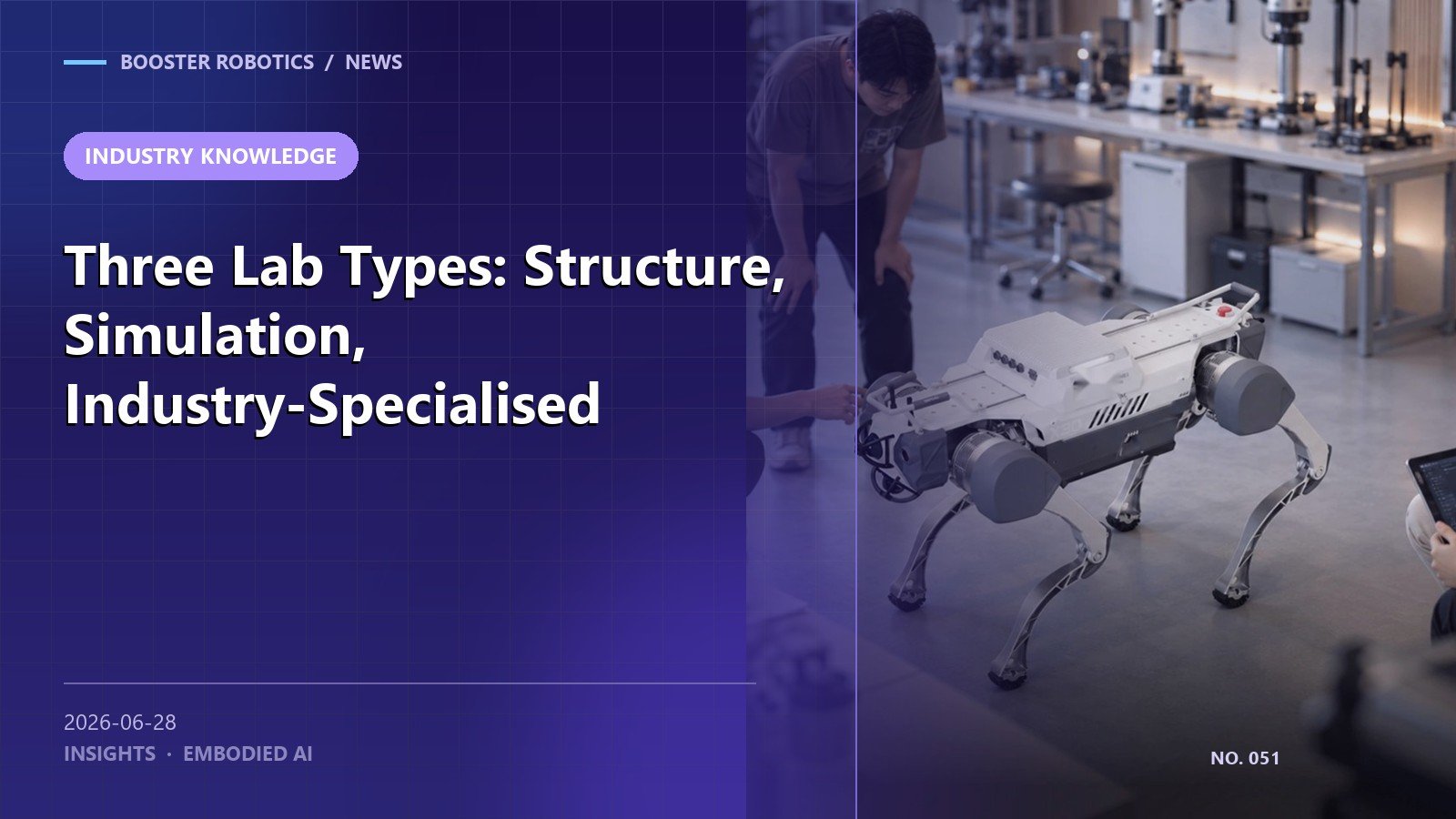
Three Lab Types: Structure, Simulation, Industry-Specialised
One room with robots in it is not a laboratory strategy. The three-type model behind Booster's humanoid robot laboratory solution divides the work by purpose: a structure and principles lab where students learn the machine itself, a simulation and development lab where behaviours are built and verified, and an industry-specialised lab where real sector scenarios are run to workplace standards. This article explains what happens in each type, how students progress between them, and how institutions can phase the build.
EAP-Style Certification for Robotics Students, Explained
A robotics certificate can mean anything from attendance to genuine, examined competence - and employers have learned to ask which. This article explains EAP-style certification for robotics students: skills credentials built around practical assessment against industry-referenced standards. It covers what gets examined - operation, deployment, safety, documentation - how the assessment is structured, and how colleges should position certification inside a programme so the credential signals something real to the employers who filter by it. The standard behind the certificate is what gives it value.
Teacher Training for Embodied AI Labs: A Practical Model
An embodied AI laboratory is only as good as the teachers who run it, and those teachers are usually asked to master a new platform, a new toolchain and a new pedagogy simultaneously. This article sets out a practical robotics teacher training model: the sequence that takes an instructor from first contact with the robots to confident classroom delivery, the competencies to certify at each stage, and the refresher rhythm that keeps teaching current in a field that updates itself yearly.
The Five-Element Path: Majors, Courses, Teachers, Bases, Textbooks
Industry-education integration fails when a college buys robots and calls it a programme. The five-element path treats integration as a system with five load-bearing parts - the major, its courses, its teachers, its training bases and its textbooks - each developed against the others. This article explains the framework element by element: what 'golden' means as a standard for each, how the elements reinforce one another, and how an institution can audit its own programme against the five before investing further.
Vocational Robotics Training: Aligning Courses With Real Industry Posts
Vocational robotics courses fail in one predictable way: they teach the robot the college owns instead of the job the employer is hiring for. This article explains how a vocational robotics training solution is aligned backwards from real industry posts - robot operator, maintenance technician, integration assistant - into course modules, laboratory exercises and assessable skills. It covers the employer conversations that should precede the curriculum, and how the laboratory's three training layers map onto the first years of a graduate's career.
K-12 Humanoid Robots: Safety and Class Management Basics
Bringing a walking humanoid into a classroom of twelve-year-olds is a safety and classroom-management design problem before it is a technology purchase. This article covers the basics that make it work: why robot size and speed matter more than any single safety feature, how to structure sessions so thirty students and one machine stay orderly, the floor rules worth posting on the wall, and the supervision and maintenance routines that keep a K-12 humanoid robot an asset instead of an incident report.
STEM Robotics With Real Humanoids: A School Program Blueprint
Most school robotics stops at tabletop kits and screen simulators. A STEM robotics education programme built on a real humanoid raises the ceiling: students work with the actual machine class that universities and industry use, and the concepts stop being abstractions. This blueprint sets out how to design such a programme - the learning outcomes to target, how many robots a cohort really needs, what teachers must be able to do before term starts, and how to assess work that happens partly on a football pitch.
Robot Football as a Teaching Tool: From Classroom to Competition
Football gives robotics teaching something textbooks struggle to provide: a reason to care by Friday. A robot football education program uses the game as its curriculum spine - perception to find the ball, control to walk and kick, teamwork to win - and carries students from their first scripted behaviour to a competition team with real opponents. This article explains why the format teaches so effectively, how a programme is structured across a school year, and what schools should look for in a platform and partner.
RoboCup Explained: Why Robot Soccer Matters for Real Robots
RoboCup looks like a game and functions like an examination. Robot soccer compresses everything hard about humanoid robotics - walking on real grass, seeing a moving ball, deciding under time pressure, surviving collisions - into ninety public minutes with no retakes. This article explains what RoboCup is, why the research community has used football as its benchmark for nearly three decades, and what teams and buyers should read into results achieved on a RoboCup humanoid robot platform, including a world title won after a 28-year wait.
Humanoid Robot Certifications: CE, FCC, KC, MIC and UN38.3 Decoded
A humanoid robot's certification list looks like alphabet soup - CE, FCC, CB, KC, MIC, WPC, UN38.3 - but each mark unlocks a specific market or a specific permission, such as shipping a lithium battery by air. This article decodes the list mark by mark: what each certification tests, which authority stands behind it, and why buyers should read the list as a map of where a platform can legally and practically go. The reference is the Booster T1's verified certification set, one of the widest in its class.
Battery Endurance in Humanoids: Walking Hours vs Standing Hours
Humanoid spec sheets quote two endurance numbers - walking hours and standing hours - and the gap between them confuses buyers. It comes down to physics: walking is the most expensive thing a biped does, standing still is among the cheapest. This article explains where a humanoid's battery actually goes, what the Booster T1's two walking hours and four standing hours - and the compact K1's fifty minutes of continuous walking - mean for planning a teaching day, a competition or a demonstration schedule.
Quasi-Direct-Drive Actuators: Why Humanoid Joints Feel Different
Two humanoids with identical degrees of freedom can move like entirely different species, and the difference usually lives in the joints. This article explains humanoid robot actuators in plain terms: why classic high-ratio gearboxes make robots stiff, fragile and hard to control, what quasi-direct-drive actuation changes - low reduction, backdrivability, torque sensed through the motor itself - and how those properties connect to the fall-and-recover, push-resistant movement buyers see in demonstrations and should test in person. That difference decides how the robot survives contact with the real world.
Depth Cameras, IMUs and Microphone Arrays: A Humanoid Sensor Tour
A humanoid robot's spec sheet lists its senses in a single line - depth camera, 9-axis IMU, microphone array - and moves on. This tour slows down: what each sensor actually measures, which capability collapses without it, and how the three divide the work of seeing, balancing and hearing. Using the Booster T1's verified sensor fit as the reference, it is a field guide for buyers reading any humanoid specification and wondering which lines deserve their attention. Each line of the specification earns its place.
SLAM and LiDAR: How Service Robots Know Where They Are
A service robot that cannot answer 'where am I?' to within a few centimetres cannot work in a live building. The technology that answers the question is SLAM - simultaneous localisation and mapping - usually built on LiDAR. This article explains, in plain terms, how a robot constructs a map while navigating by it, why the map keeps trying to drift and how loop closure fixes it, how LiDAR and depth vision divide the sensing work, and what navigation quality looks like when you evaluate a platform for halls, campuses and plants.
Robot Fleet Management Software: What Operators Actually Need
Fleet software is usually specified by engineers and judged by demos, then lived with by operators. This article flips the perspective: what the people who run robot fleets every day actually need from robot fleet management software - an honest status view, exceptions presented as decisions, maintenance that plans itself from usage data, and reports that answer management's real questions. It closes with the demonstration tests that reveal whether a platform serves the operator or merely impresses the procurement team.
Multi-Robot Scheduling: How Fleets Share Work Without Chaos
One robot is a machine; ten robots are a traffic problem. A multi-robot coordination platform is the layer that turns a fleet into a system - assigning tasks to the right unit, keeping shared spaces collision-free, rebalancing work when a flight bank lands early, and knowing which robot should rest, charge or take the next cart. This article explains the scheduling problem in plain terms, the decisions the platform makes every few seconds, and what buyers should test when a supplier demonstrates fleet software.
Full-Process Traceability: Why Airports Track Every Bag Digitally
When a passenger asks where their bag is, 'somewhere in the system' stopped being an acceptable answer years ago. Full-process traceability records every bag's journey digitally - each scan, each machine, each handover - so the answer is a lookup, not a search party. This article explains what a complete baggage record contains, how robot fleets generate it as a by-product of working, and why traceability has become a deciding requirement when airports evaluate any baggage handling data system. Completeness, not speed, is the point.
VLA Models Explained: From Language Instructions to Robot Action
A Vision-Language-Action (VLA) model does something robot software historically could not: take a camera view and a sentence - 'load the red suitcase onto the cart' - and produce the motion directly. This primer explains how VLA models are put together and trained, what they are genuinely good at, where they still fail, and how they relate to wider embodied architectures such as VTFLA. It is written for buyers and engineers who need to evaluate VLA claims in a supplier's presentation without a research background.
What Is VTFLA? Vision, Tactile, Force, Language and Action in One Model
Most robot models see and act. VTFLA adds the channels that physical work actually runs on: touch, force and language, unified with vision and action in one architecture. This article explains each of the five channels in plain terms, why a baggage robot needs to feel a slipping suitcase rather than just see it, how language enters the loop as instructions and queries, and what the architecture means for buyers evaluating embodied AI systems for real-world handling work. Buyers take away the questions that expose vision-only systems.
Suction Cup vs Gripper: How Baggage Robots Hold a Suitcase
How a robot holds a suitcase decides whether the line runs or jams. Suction cups are fast and gentle but fail on textured, curved or porous shells; mechanical grippers are secure but must fit the bag and respect its contents. This article compares the two honestly - the surfaces each handles, the ways each fails, and why serious transfer robots combine both in one composite end effector. It closes with the grip range and sensing questions buyers should ask when a baggage robot's brochure simply says it handles standard luggage.
Why Irregular Baggage Breaks Fixed Automation - and What Handles It
Fixed baggage automation is engineered for the suitcase: rigid, rectangular, predictable. Real baggage halls also receive backpacks that slump, handbags that swing and soft cases that change shape under a gripper - and each one can stop a line built for boxes. This article explains the physics of why irregular bags defeat fixed machinery, what a flexible baggage handling robot does differently with two arms and depth vision, and where the boundary sits between flexible handling and the work that should stay manual.
Airport Baggage Handling Automation: The 80/10/10 Model Explained
Full automation is the wrong target for an airport baggage hall, because the last ten percent of bags defeat fixed machinery. The 80/10/10 model takes a more practical route: automated transfer robots carry the standard flow, a flexible humanoid handles the irregular minority, and people keep the true exceptions. This article explains how the split works in a working terminal, why the percentages fall where they do, what each layer needs from the others, and how an airport can pilot the model on one transfer link without rebuilding the hall.
Industrial O&M Patrols: Cutting Routine Rounds With Legged Robots
Routine patrol rounds consume skilled technicians' hours on work that is mostly walking and looking. An industrial operation and maintenance robot changes the arithmetic: a legged platform walks the round on schedule, reads gauges and temperatures with its payload, photographs what it finds and files a record nobody has to chase. This article explains where these patrols fit in a plant's maintenance system, which checks transfer well to a robot and which stay human, how the data should flow into maintenance planning, and the questions O&M managers should ask before committing a line to robotic rounds.
Campus Patrol Robots: What a Good Deployment Looks Like
A campus patrol robot earns its keep quietly: fixed routes walked on schedule, cameras and sensors watching the hours people cannot, and a security team that receives records instead of rumours. This guide walks through what a good deployment looks like - route and schedule design, payload choices, how the robot works alongside guards rather than replacing them, and the governance questions a university or park operator should settle before the first patrol. It draws on real campus patrol practice, including a university deployment where a quadruped covers routine rounds and flags abnormal behaviour for human review.
Case Reading: What Zhejiang University Teaches About Embodied Labs
Case studies are usually read for reassurance; they are more useful read for method. The embodied AI research lab work at Zhejiang University - where a flagship quadruped equipped with an embodied navigation system performs campus-scale research duties - offers three transferable lessons for any institution building an embodied laboratory: anchor the lab in a working application, let research and service share the same robots, and build the platform layer before the fleet grows. This article reads the case closely and extracts the decisions other universities can copy, whatever platforms they buy.
The Developer Ecosystem Around a Humanoid: SDK, Docs and Community
Two laboratories can buy the same humanoid and get different research programmes out of it - the difference is the ecosystem around the machine. A humanoid robot SDK that exposes the right layers, documentation a new student can actually climb, simulation tools wired into the deployment pipeline, and a living community of teams publishing code and results: these decide how fast a laboratory produces work. This article audits the ecosystem layer by layer, with the questions evaluators should ask and the timed tests that reveal more than any feature list.
General-Purpose Humanoid Robots: Hype vs Working Reality
The general-purpose humanoid robot is the most promised machine of the decade and the most unevenly delivered. This article separates the working reality from the hype with a buyer's cold eye: the domains where humanoids already earn their cost - research platforms, education, competition, defined handling and demonstration duties - the domains still ahead of the technology, and the evaluation habits that protect institutions from paying tomorrow's promises at today's prices. Booster builds and sells humanoids; this is our honest map of where they work, including where we tell customers not to buy one yet.
Embodied AI Terminology: 25 Terms Every Buyer Should Know
Robot quotations are written in a dialect, and buyers who cannot parse it negotiate blind. This glossary defines the 25 terms that decide real capability in embodied AI purchasing - what each term means, why it appears in specifications, and the question it should prompt. From embodied AI itself, VLA models and sim-to-real training to degrees of freedom, whole-body control, disturbance rejection and fleet platforms: plain definitions, no marketing fog, cross-referenced to the detailed explainers elsewhere in the Booster Robotics news archive.
Data Platforms for Robot Fleets: From Alerts to Maintenance Planning
A single robot needs an operator; a fleet needs a memory. The data platform above a robot fleet is where alerts, health telemetry, task histories and maintenance records accumulate into the asset an operator actually manages: availability. This article explains what a robot operation and maintenance platform does - live fleet status, alert triage, predictive maintenance signals drawn from the robots' own telemetry, and the reporting layer that turns robot work into management evidence - and why the platform, not the dashboard's looks, decides whether a fleet scales past five units.
Night Patrol: How Robots Cover the Hours People Cannot
The riskiest hours of a facility are the emptiest ones. Between the last staff leaving and the first arriving, sites rely on a guard's round, a camera wall nobody watches continuously, and luck. Night patrol robots change that arithmetic: a security patrol robot walks the perimeter and the plant rooms on schedule all night, every night, checking, recording and escalating - not replacing the security team, but giving it eyes that never blink during the hours it cannot staff. This article sets out the night-patrol pattern, its honest limits, and how sites structure the human-robot rota.
A park or campus is inspected properly perhaps a few times a year - and changes every day. Environmental patrol closes that gap: an autonomous patrol robot walks defined rounds on a schedule, checking lighting, paths, litter hotspots, damaged fixtures, water and vegetation issues, and reporting every finding with its location and imagery into the maintenance system. This article explains what an environmental round actually contains, how the findings become work orders instead of footage, and why legged platforms suit grounds that were never designed for machines.
Medical Support Scenarios for Legged Robots, Realistically
Hospital robot coverage oscillates between miracle and menace, and both are unhelpful. This article takes the realistic middle: the support scenarios a legged service robot for hospitals can genuinely perform today - internal logistics between departments, scheduled observation and condition rounds, and presence in spaces that are short-staffed at night - together with the constraints that bound them: infection control, patient safety, lift-and-door infrastructure, and the absolute line between support work and clinical work. Written for facility and innovation managers evaluating pilots, not headlines.
Public Service Robots: Delivery, Patrol and Environmental Rounds
Public spaces are the hardest classroom a robot can attend: uncontrolled people, weather, terrain that changes with the seasons, and work that is judged by the public it serves. Yet the public service robot is finding real work there - light delivery across campuses and parks, patrol rounds that keep facilities observed through the night, and environmental rounds that check, report and tidy the data layer of public space. This article surveys the three roles honestly: what each involves, the platforms suited to them, and the acceptance lessons that decide whether a pilot becomes a fixture.
Peak Season Math: Staffing Baggage Halls vs Automating Transfer
Baggage halls are staffed for the average and punished at the peak. Flight banks, holiday surges and disruption days multiply the bag flow for hours at a time, while rosters, hiring and training move in weeks. This article does the arithmetic honestly: how peak demand actually looks in a transfer hall, what staffing alone can and cannot do about it, and where a baggage transfer robot changes the equation - a flat, tireless capacity line under the standard flow, with human teams redeployed to the exceptions and peaks that genuinely need judgement.
Planning a Smart Airport Pilot: Start With One Link in the Chain
Airport automation programmes fail by ambition: a whole terminal, every process, one big-bang contract - and a pilot that proves nothing because it changed everything. The programmes that succeed start with one link in the chain. This guide to planning a smart airport solution pilot uses baggage transfer as the worked example: selecting the pilot link by pain and measurability, defining success metrics before the robots arrive, running the pilot inside live operations without disturbing them, and scaling only what the evidence supports.
Humanoid Robot Price Factors: What Drives the Quotation?
Two humanoid robots can differ in price by an order of magnitude while looking similar in a photograph. The quotation is written by the specification: physical scale and degrees of freedom, actuator quality, on-board AI compute, the sensor suite, endurance, certifications for the destination market, and the software, training and service layers wrapped around the machine. This article opens the quotation up factor by factor - using the Booster T1 and K1 as worked examples of how humanoid robot price and specifications relate - so buyers can compare offers line by line instead of headline by headline.
Total Cost of Ownership for Research Robots: Beyond the Purchase Price
The purchase price of a research robot is the most visible number in the budget and often the least representative. Across a three-year life, training, curriculum development, spare parts, battery replacement, software, service, staff time and - above all - utilisation decide what each productive robot-hour actually cost. This article builds the total-cost-of-ownership model for humanoid and quadruped research platforms, names the cost lines buyers most often forget, and shows why the cheapest humanoid robot price can produce the most expensive laboratory.
Buying Robots for a University: A Procurement Checklist
University robot purchases fail in predictable places: the specification that ignored the software, the budget that forgot training, the delivery that missed the semester. This procurement checklist is written for the people who sign - laboratory directors, procurement officers and principal investigators - and covers the full decision: defining the teaching and research use cases first, the platform criteria that matter, the software and curriculum layers that decide whether robots get used, service and certification requirements, and acceptance testing on delivery. Use it to buy a humanoid robot for laboratory programmes that are still running in year three.
From Simulation to Field: Verifying a Policy Before Deployment
A policy that performs in simulation has passed an audition, not an examination. Between the simulator and the field stands a verification discipline: staged hardware rollouts, regression metrics that compare every new policy version against the last, environmental stress cases, and rollback plans for the day a field behaviour surprises everyone. This article maps that ladder for robot policy training and deployment - the same sim-to-real pipeline Booster uses to ship locomotion and manipulation updates - and gives research teams a verification checklist they can apply to their own policies before those policies touch shared spaces.
Disturbance Rejection: Humanoids That Stay Standing When Pushed
A biped stands on a support polygon the size of two feet - sometimes one - and the world is under no obligation to respect it. Disturbance rejection is the capability that answers pushes, bumps, snagged loads and uneven ground: sensing the disturbance as it begins, replanning support in milliseconds, and spending a step, a lean or an arm swing to buy back balance. This article explains the physics honestly, the recovery strategies controllers combine, and why disturbance rejection is the everyday working skill of a bipedal humanoid robot in schools, laboratories and competition halls.
Fall and Get Up: Why Recovery Skills Matter More Than Walking
Every biped falls. The difference between a research platform and a toy is what happens next: whether the robot protects itself in the fall, assesses its pose, and returns to standing unaided - or waits on the floor for a human to pick it up and the experiment to restart. This article argues that humanoid robot fall recovery is the most underweighted skill in purchasing decisions, explains how recovery behaviours are trained and verified, and shows why venues from RoboCup pitches to school classrooms are where recovery earns its keep.
Whole-Body Control: The Hard Problem Behind Humanoid Balance
A humanoid robot is a machine that is always falling and constantly deciding not to. Whole-body control is the discipline that makes those decisions: coordinating every joint - legs, torso, arms - as one system, so the robot can walk, turn, reach and carry while keeping its balance on a support that is sometimes a single foot. This article explains why balance is a whole-body problem rather than a leg problem, how modern controllers prioritise tasks when joints must serve several masters, and what whole-body motion control makes possible in working humanoids like the Booster T1.
Force Control in Gripping: Firm Enough, Gentle Enough
Every grip is a negotiation between two failures: too little force and the object slips; too much and it is crushed, torn or marked. Force control is how robots conduct that negotiation - sensing contact, closure and load in real time and regulating grip continuously instead of squeezing to a preset position. This article explains the sensing channels involved, why soft and irregular goods make force control non-negotiable, and how it works together with tactile feedback and composite end effectors in a flexible gripping robot handling everything from rigid suitcases to soft handbags.
Dexterous Manipulation: Teaching Robots to Grip Soft, Odd-Shaped Objects
Rigid automation grips the same box a million times. The real world hands a robot a soft backpack, a bulging duffel, a handbag with straps - objects that deform, shift and refuse to be modelled precisely. Dexterous manipulation is the discipline of gripping exactly those objects: perceiving shape and material cues, planning a grasp that tolerates uncertainty, and closing an end effector that adapts instead of crushing. This article explains the perception-to-grasp pipeline, the end-effector designs that handle soft goods, and why irregular baggage became one of the proving grounds for the dexterous manipulation robot.
Payload Planning for Inspection Robots: Cameras, LiDAR and Arms
An inspection robot is its payloads, carried well. Cameras, thermal imagers, LiDAR units, gas sensors and manipulator arms decide what the robot can measure - yet payload selection is often treated as a catalogue browse at the end of a purchase. This guide reverses the order: start from the reading list the programme must produce, work through the sensing each reading requires, then balance mass, power and mounting against the platform's budget. It covers the main quadruped robot payloads and accessories, the integration questions that decide whether data flows or fragments, and a planning sequence any inspection team can follow.
Dual-Spectrum Gimbals: Seeing Heat and Light on Patrol
Some things a patrol robot needs to see do not reflect light at all - they radiate heat. A dual-spectrum gimbal camera pairs a conventional visible-light camera with a thermal imager on one stabilised, steerable mount, so a quadruped robot can read a scene in both spectra at once: the cabinet label in visible light, the overheating bearing in thermal. This article explains how the two channels complement each other, why the gimbal matters as much as the sensors, and the patrol and inspection jobs - night rounds, electrical checks, search tasks - where dual-spectrum payloads earn their place.
Behaviour Analysis in Patrol Robots: Detecting the Abnormal
A patrol robot that only records video is a camera with legs. The value arrives when the system knows what normal looks like - and can say, with evidence, when a scene departs from it. Behaviour analysis gives patrol robots that judgement layer: baselines of ordinary activity per route and hour, detection of loitering, intrusion, abandoned objects and unusual gatherings, and alerts packaged with the clip and location a human operator needs to decide. This article explains how behaviour analysis works on a security patrol robot dog, where its limits honestly sit, and how to evaluate alert quality before deployment.
Embodied Navigation: How Quadrupeds Build 3D Maps of Their World
A robot that patrols a substation or a campus cannot follow a painted line - it has to understand the space it moves through. An embodied navigation robot builds that understanding itself: LiDAR and depth sensors sweep the environment, mapping algorithms assemble the returns into a three-dimensional model, and localisation keeps the robot placed inside its own map metre by metre. This article explains how the mapping, localisation and route-planning layers fit together, why 3D matters on stairs, ramps and cluttered plant floors, and what buyers should ask when a supplier claims autonomous navigation.
Booster Robotics Ships More Than 1,000 Robots in 2025, Reaching RMB 100 Million in Revenue
Booster Robotics closed 2025 with more than 1,000 robots shipped, revenue of RMB 100 million, and more than 200 customers across over 20 countries - over 40 percent of them overseas. Two years after founding, the company has moved from research spin-off to scaled delivery: humanoid robots from the T1 and K1 lines are working in top laboratories, universities and K-12 schools worldwide, developed together with more than 30 leading research institutions and companies and backed by dozens of top-tier publications.
China's First RoboCup World Title in 28 Years - Won on a Booster-Class Platform
At RoboCup 2025, a Chinese university team won the robot soccer world title - the first for China in 28 years - competing on the class of humanoid platform that Booster Robotics builds for developers and universities. The result caps a season in which Booster-powered entries also swept the football medals at the World Humanoid Robot Games. For Booster, founded by members of the Tsinghua Vulcan robot football team, the title is both a homecoming and a proof point: the same reinforcement learning and sim-to-real toolchain is available to every customer team.